
Building pipes
Pipes in buildings: an Edmonton guide
Most of a building’s water system is out of sight: inside walls, above ceilings and in shafts shared by many suites. These guides explain what those pipes are made of, why they fail, how hidden leaks are found and how an owner or board can compare its options. Each guide lists the public sources behind it.
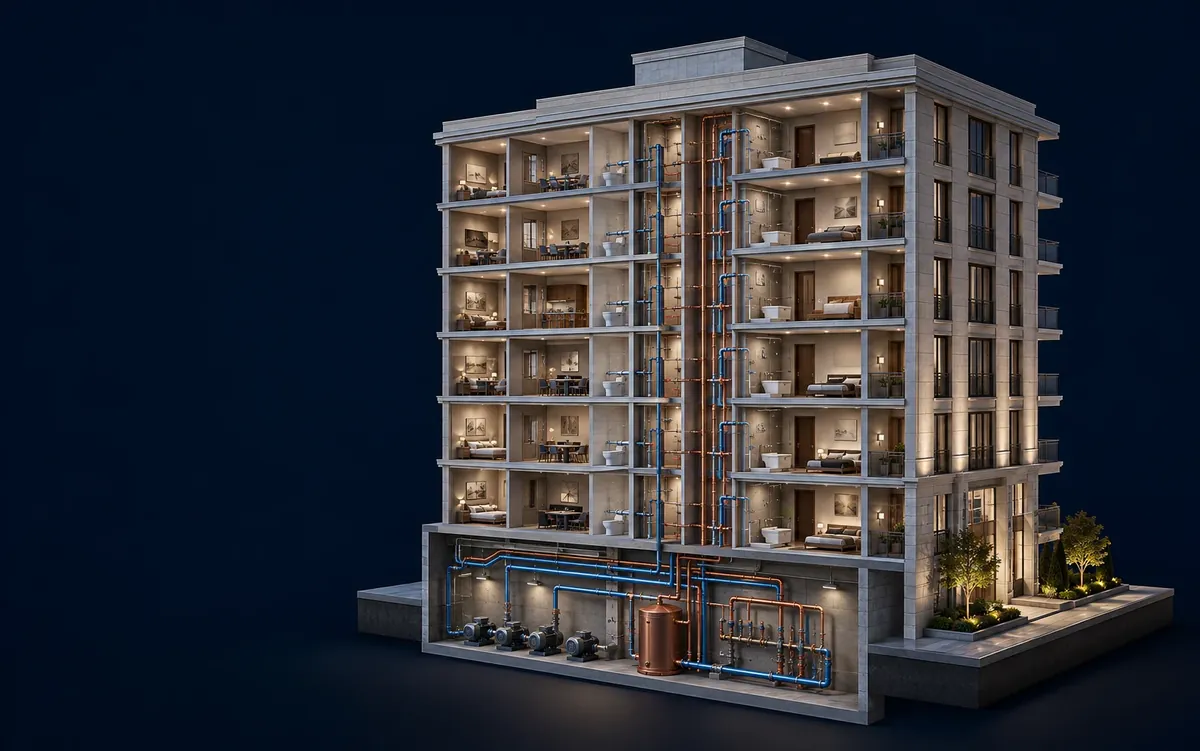
The domestic water system reaches every suite, under pressure.
A multi-unit building has separate pipe systems for domestic hot and cold water, drains, heating and, where fitted, fire sprinklers. The domestic water system is under pressure and reaches every suite: the National Plumbing Code of Canada requires a pressure-reducing valve where static pressure at a fixture may exceed 550 kPa. A failure in that system can release a lot of water until the line is isolated.
Public sources describe several recurring causes of failure: pitting corrosion in copper, chlorine-related degradation of Poly-B (the Insurance Bureau of Canada’s explanation; other sources point to fittings and installation), ice blockages in frozen pipe, and failures at fittings. One failure is a repair. Several in the same building are a question about the whole system, and the useful first step is evidence, not an estimate.
Start with your situation.
Choose the sentence that sounds like your building.
- Water is leaking now: read the water leak emergency checklist, then call for help.
- A pinhole leak has appeared, or keeps returning: pinhole leaks in copper pipes, then recurring pinhole leaks in condominiums.
- The building has Poly-B: Poly-B pipe in Edmonton condominiums.
- You do not know what pipes the building has: pipe materials in condominium buildings, then how long building pipes last.
- The board is comparing options: repipe, line or treat, then pipe condition assessment. The condo board guide covers reserves, insurance and projects.
- You suspect a leak you cannot see: how hidden pipe leaks are found.
- Hot water return lines keep failing: hot water recirculation and pipe corrosion.
- You wonder whether Edmonton’s water is to blame: Edmonton’s water and copper pipes.
- You are not sure which system is leaking: water, drain, heating and sprinkler pipes.
- You want to know how old Edmonton’s condominium buildings are: Edmonton condo buildings by year built, counted from City open data.
- Winter is coming: winter pipe burst risk in Edmonton condos.
What is in the walls.
A United States research team says central multifamily hot water systems generally have a pumped recirculation loop to deliver hot water more quickly to individual dwelling units, with non-recirculating branch lines that feed the individual units.
Separate systems carry waste and vent air, heating water and fire-sprinkler water. They can look alike behind a wall and can fail in different ways. Water, drain, heating and sprinkler pipes explains how to tell them apart.
Why pipes fail.
The causes of failure described in public sources fall into a few families. Knowing which one you are dealing with helps decide what will help.
- Corrosion. Copper can develop pits that can breach the pipe wall, which is a pinhole leak. See hot water recirculation and pipe corrosion for one driver.
- Material degradation. Some plastic pipe can degrade. The Insurance Bureau of Canada says Poly-B is susceptible to breaking because of its reactivity with chlorine in water and its sensitivity to UV light, and the Plastics Pipe Institute says frequent or continuous exposure of PEX to water conditions beyond those used in its ASTM F2023 test may cause premature oxidation and eventual brittleness. See Poly-B pipe in Edmonton condominiums.
- Freezing. It is a risk where pipes sit near outside walls, where the water line enters the building, and in a vacant home, where the Insurance Bureau of Canada advises shutting off the water supply and draining the lines. See winter pipe burst risk in Edmonton condos.
- Age, workmanship and fittings. The Copper Development Association, a U.S.-based association of the copper industry, says faulty workmanship that leaves excess flux inside copper tube can cause or intensify pitting, and Alberta Municipal Affairs says that in Poly-B piping, plastic insert fittings and aluminum bands are reported to be more susceptible to failures causing leaks than the copper or brass insert fittings and soft copper crimping rings primarily used in Alberta. See how long building pipes last.
What ProShield does, and what it does not.
ProShield investigates water leaks, documents what it finds and helps buildings plan protection. That includes LEaC Shield assessments for recurring pinhole leaks and leak sensors and automatic shutoff planning. For a leak that cannot be found, see water leak detection.
Repair and replacement of piping should be left to qualified trades. In Alberta only listed classes of individuals, such as trade certificate holders and apprentices, may perform restricted activities in the plumber trade, and a plumbing permit is required to install, alter or add to a plumbing system. These guides explain the options so that an owner or board can ask better questions of any provider, ProShield included.
How these guides are written.
Each guide is written for Edmonton and Alberta conditions and aims to list the public documents behind its main factual statements: government agencies, utilities, standards bodies, industry associations and manufacturers’ technical papers. It tries to say where a source comes from outside Alberta or Canada, and where sources differ or the answer depends on the building.
Nothing here is engineering, legal or insurance advice. A building’s own drawings, records, professionals and policy wording decide.
Sources and further reading
- National Plumbing Code of Canada 2020, Division B (copy hosted by the Regional District of Nanaimo)
- Air-Conditioning, Heating, and Refrigeration Institute: Hydronic heating
- US OSHA: 29 CFR 1910.155, definitions including sprinkler system (United States)
- Health Canada: Guidelines for Canadian Drinking Water Quality, technical document on copper (2019)
- Insurance Bureau of Canada: Know your home’s history and the issues lurking within its walls (2025)
- Polybutene Piping Systems Association: Answers to frequently asked questions (an association whose members sell polybutene-1 piping systems)
- University of Illinois Building Research Council: An investigation into freezing and bursting water pipes in residential construction (1996)
- Alberta Municipal Affairs: Safety tips on polybutylene (Poly-B) pressure water piping (2016)
- US Department of Energy Building America: Strategy guideline, proper water heater selection (2015)
- Plastics Pipe Institute: TN-53, Chlorine resistance ratings of PEX pipe and tubing (2025)
- Insurance Bureau of Canada: Does my insurance cover damage caused by extreme cold?
- EPCOR: Prevent frozen water pipes in winter
- Copper Development Association: About CDA (an association of the copper industry)
- Copper Development Association: Copper Tube Handbook (2026)
- Alberta Designated Trades and Restricted Activities Regulation (Alta Reg 161/2022)
- Alberta Permit Regulation (Alta Reg 204/2007)
- Health Canada: Guidance on controlling corrosion in drinking water distribution systems (2025)
- Plastics Pipe Institute: Ultraviolet resistance of PEX tubing (2021)
- Service Alberta: Condominiums, responsibility for repair and maintenance (2024)
Questions people ask
What are the pipes in a condominium building made of?
A building can have more than one material, for example where repairs and renovations have replaced some runs and left others. Health Canada describes copper plumbing with lead–tin solders (widely used until 1989) and brass faucets and fittings as predominant in domestic plumbing systems, Alberta Municipal Affairs dates Poly-B from the mid-1970s until manufacturers stopped producing it in 1998, and the Plastics Pipe Institute says PEX was introduced to the United States and Canada in the 1980s. The building’s drawings, permits and records, and a physical check, are the way to find out what your building has.
Who is responsible for a leaking pipe in an Alberta condominium?
It depends on the condominium plan and the bylaws. Service Alberta says the plan may show which items, such as pipes, are common property, and that unit owners are typically responsible for repairing and maintaining their units unless the bylaws say otherwise. Read those documents first. The corporation’s insurer or a lawyer can confirm how they apply.
Does ProShield replace pipes?
No. ProShield investigates leaks, documents what it finds and helps a building plan protection. Replacement and repair of piping should be left to qualified trades; in Alberta only listed classes of individuals, such as trade certificate holders and apprentices, may perform restricted activities in the plumber trade.
Where should a board start if pipes keep leaking?
Start with a leak log: the date, suite, hot or cold line, location and repair for each event. It can show whether failures are random or clustered, which helps a board decide whether the next step is a repair, an assessment or a wider plan.