
Recirculation lines
Hot water recirculation lines and pipe corrosion
A United States research team says central multifamily hot water systems generally have a pumped recirculation loop to deliver hot water more quickly to individual dwelling units. For PEX, the Plastics Pipe Institute distinguishes timed recirculation, with exposure to hot water up to twelve hours a day, from continuous recirculation, up to twenty-four hours a day. A 2017 Foundation for Water Research review of the causes of copper corrosion says erosion corrosion is usually found in hot water recirculating systems. Separately, BC Housing says domestic hot water recirculation pipes are generally the first pipes to start leaking, followed by space heating hot water pipes and then cold water pipes. Alberta Municipal Affairs says Poly-B remained acceptable for potable water systems but was not to be used for continuous circulating hot water lines, as listed in the 1995 National Plumbing Code of Canada, and the Plastics Pipe Institute says continuous recirculation of hot chlorinated water through PEX at commercial temperatures above 140 °F is beyond the intended application of the standard chlorine ratings.
By ProShield Leak Detection Inc. · Updated
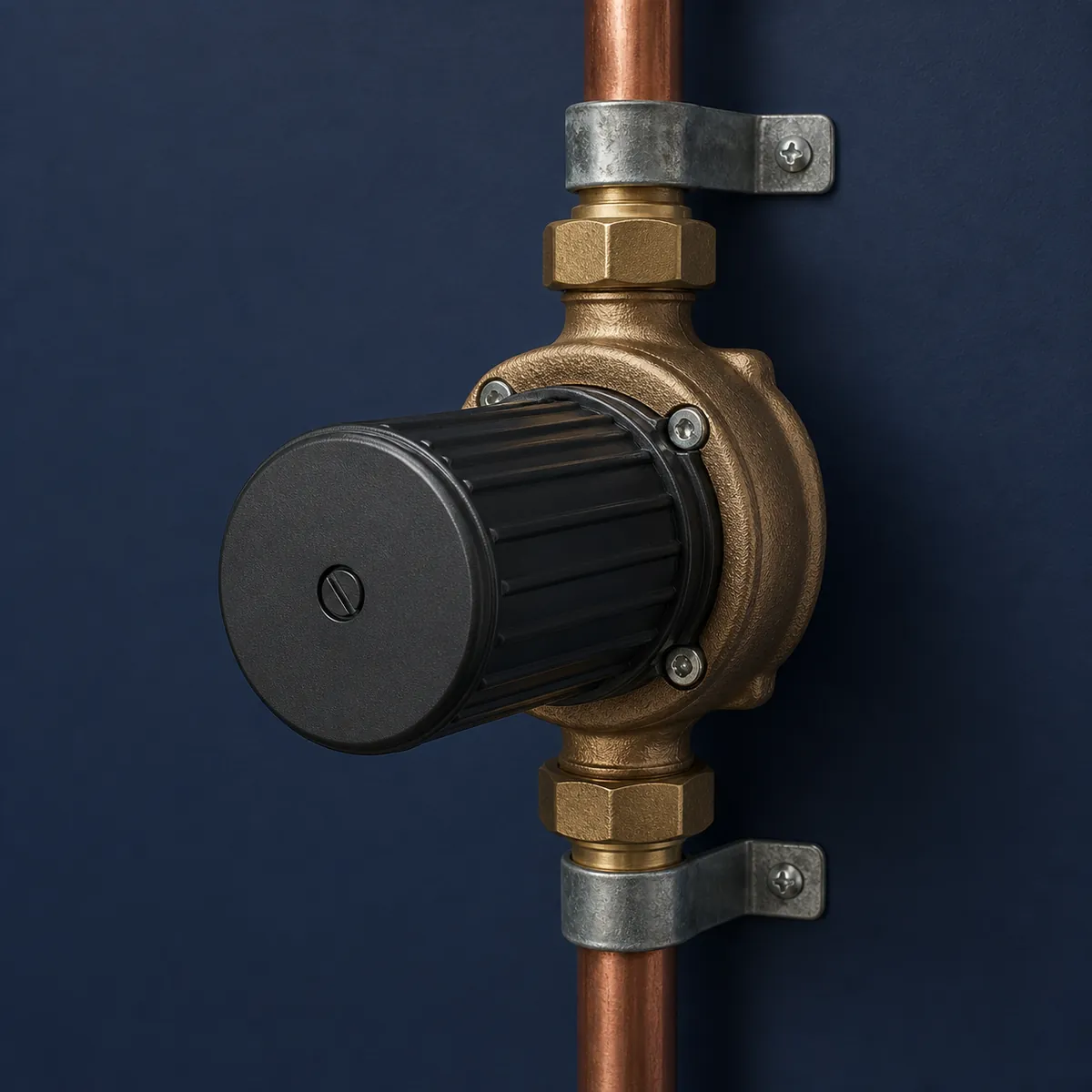
Constant circulation of hot water can be harder on pipe than occasional use.
A recirculation loop keeps hot water moving between the water heaters and the suites, through a supply riser and a return line driven by a pump. Because the water moves continuously and stays hot, the pipe is exposed to those conditions for hours a day. The Copper Development Association says that, due to constant circulation and elevated water temperatures, particular attention should be paid to water velocities in circulating hot water systems.
The same principle applies to plastic pipe. Alberta Municipal Affairs says Poly-B remained an acceptable product for potable water systems, but was not to be used for continuous circulating hot water lines, as listed in the 1995 National Plumbing Code of Canada. The Plastics Pipe Institute says continuous recirculation of hot chlorinated water through PEX at commercial temperatures above 140 °F is beyond the intended application of the standard chlorine ratings. Continuous hot water circulation is a distinct, more demanding duty.
How a recirculation loop works.
In many multi-unit buildings, hot water leaves the heater or boiler, travels through a supply riser and branches to the suites. A return line brings the unused water back so hot water is available quickly, and a pump keeps it moving.
Flow is not the same everywhere in the loop. The Copper Development Association says that if the rough inside edge left by cutting copper tube is not removed by reaming, erosion-corrosion may occur due to local turbulence and increased local flow velocity.
Erosion-corrosion: how fast, hot water wears copper.
Erosion-corrosion is a form of corrosion that speeds up where water moves fast or turbulently. Health Canada says that in building hot water systems a water temperature above 60 °C, in the presence of high flow velocity, is a factor in erosion corrosion. A UK review says erosion corrosion is usually found in hot water recirculating systems, where leakage can occur in a matter of weeks to months, and is caused by continuous high water velocities, especially in hot water return lines.
The Copper Development Association recommends design limits: no more than 8 feet per second (about 2.4 metres per second) for cold water and 5 feet per second (about 1.5 metres per second) in hot water up to approximately 140 °F. Where temperatures routinely exceed 140 °F, it says lower velocities such as 2 to 3 feet per second (about 0.6 to 0.9 metres per second) should not be exceeded, and that both supply and return piping should be sized so the maximum velocity does not exceed those limits. These are industry design guidance; the research for this guide found no velocity limit for copper in the National Plumbing Code of Canada.
The UK review reports critical velocities, where damage occurs, of generally 3 metres per second in cold water and 1.5 metres per second in hot water systems running on hard water. It adds that where water has been softened to virtually zero hardness, erosion corrosion can occur in hot water recirculating systems at flow rates as low as 0.5 metres per second.
Temperature and hours of use matter as well as speed.
Health Canada says no simple relationship exists between temperature and corrosion processes. It also notes that pitting in hot water systems generally takes many years, typically more than 8 years, to perforate the pipe wall. By comparison, the UK review says erosion corrosion is usually found in hot water recirculating systems, where leakage can occur in a matter of weeks to months.
For PEX, the Plastics Pipe Institute says the first digit of the material designation code refers to chlorine resistance in one of four categories, and it describes three of them in hours of hot water per day: what it calls the traditional domestic application, with exposure to hot water (140 °F) up to six hours a day, the timed recirculation application, up to twelve hours a day, and the continuous recirculation application, up to twenty-four hours a day. A loop held near 140 °F all day and night matches that continuous case rather than the domestic or timed ones; ask the manufacturer which chlorine rating the tubing carries.
What a board can check.
These questions turn a suspicion about the loop into evidence.
- Where do the failures occur? Mark each leak on a plan as supply riser, return line, branch or fitting. A cluster on return lines can point toward velocity and temperature, although water quality and stagnation can also contribute.
- How fast is the water moving? An engineer or mechanical contractor can compare pump flow and pipe sizes with the velocity limits above, and confirm the balancing valves are set.
- How many hours a day does the loop run? The Plastics Pipe Institute describes PEX chlorine-resistance categories in hours of hot water per day, so ask whether timers or controls limit the loop’s running hours.
- What are the temperatures at the heater, the supply and the return? Any change to set points should be made by a qualified engineer or mechanical contractor.
- Is the water softened? The UK review says that where water has been softened to virtually zero hardness, erosion corrosion can occur in hot water recirculating systems at flow rates as low as 0.5 metres per second.
- What are the pipes made of? Copper, Poly-B, PEX and CPVC each have published limits on velocity, temperature or chlorine exposure. See pipe materials in condominium buildings.
- How were joints made? Unreamed cut edges and excess flux can start corrosion.
What can be done.
The options depend on what the evidence shows. Adjusting pump flow and balancing can lower velocity where the pipe is otherwise sound. Controls that reduce circulation hours reduce exposure. Sections that have failed repeatedly can be replaced with material and diameters chosen for the duty, and a corrosion-control program can be assessed where the water and the pipe make it suitable. Repipe, line or treat compares these approaches.
Repairs to a plumbing system should be left to qualified trades: in Alberta only listed classes of individuals may perform restricted activities in the plumber trade. Any change to pumps, controls or piping should be designed by an engineer or mechanical contractor.
Where ProShield fits.
ProShield does not design or repair recirculation systems. It investigates leaks, documents where water appeared and how it behaves, and helps a building see whether the pattern points to the loop. A LEaC Shield assessment reviews the domestic hot-water tanks, boilers and recirculation equipment along with the leak history. For an existing return-line leak, see hot water recirculation line leak.
Sources and further reading
- Copper Development Association: Copper Tube Handbook (2026)
- Alberta Municipal Affairs: Safety tips on polybutylene (Poly-B) pressure water piping (2016)
- Plastics Pipe Institute: TN-53, Chlorine resistance ratings of PEX pipe and tubing (2025)
- US Department of Energy Building America: Strategy guideline, proper water heater selection (2015)
- Health Canada: Guidelines for Canadian Drinking Water Quality, technical document on copper (2019)
- Foundation for Water Research (UK): Causes of copper corrosion in plumbing systems (2017)
- BC Housing: Maintenance Matters 20, managing internal water systems (2018)
- ASPE Pipeline: Plumbing design for success, understanding and preventing copper corrosion (2021)
- National Plumbing Code of Canada 2020, Division B (copy hosted by the Regional District of Nanaimo)
- Alberta Designated Trades and Restricted Activities Regulation (Alta Reg 161/2022)
Questions people ask
Why do hot water return lines leak more than cold lines?
A UK review says erosion corrosion is usually found in hot water recirculating systems and is caused by continuous high water velocities, especially in hot water return lines. That does not mean every return line will fail. Each building needs its own evidence.
What water velocity is too high for copper?
The Copper Development Association recommends that designers not exceed 8 feet per second for cold water and 5 feet per second in hot water up to approximately 140 °F, and says lower velocities such as 2 to 3 feet per second should not be exceeded where temperatures routinely exceed 140 °F. The research for this guide found no velocity limit for copper in the National Plumbing Code of Canada.
Can Poly-B or PEX be used on a recirculation loop?
Alberta Municipal Affairs says Poly-B was not to be used for continuous circulating hot water lines, as listed in the 1995 National Plumbing Code of Canada. The Plastics Pipe Institute says continuous recirculation of hot chlorinated water through PEX at commercial temperatures above 140 °F is beyond the intended application of the standard chlorine ratings. Ask an engineer and the manufacturer about the specific product.
Should we turn the hot water temperature down to reduce corrosion?
Not without engineering advice. Health Canada says no simple relationship exists between temperature and corrosion processes. Any change to set points should be made by a qualified engineer or mechanical contractor.