Repair options
Repipe, line or treat? Comparing options for failing building pipes
When pipes in a shared building start to fail, a board hears four different answers: replace the pipe, line it, treat the water, or monitor for leaks. Each solves a different problem and each has limits. This guide sets out what public sources say about all four, and the evidence a board should have before it chooses.
By ProShield Leak Detection Inc. · Updated
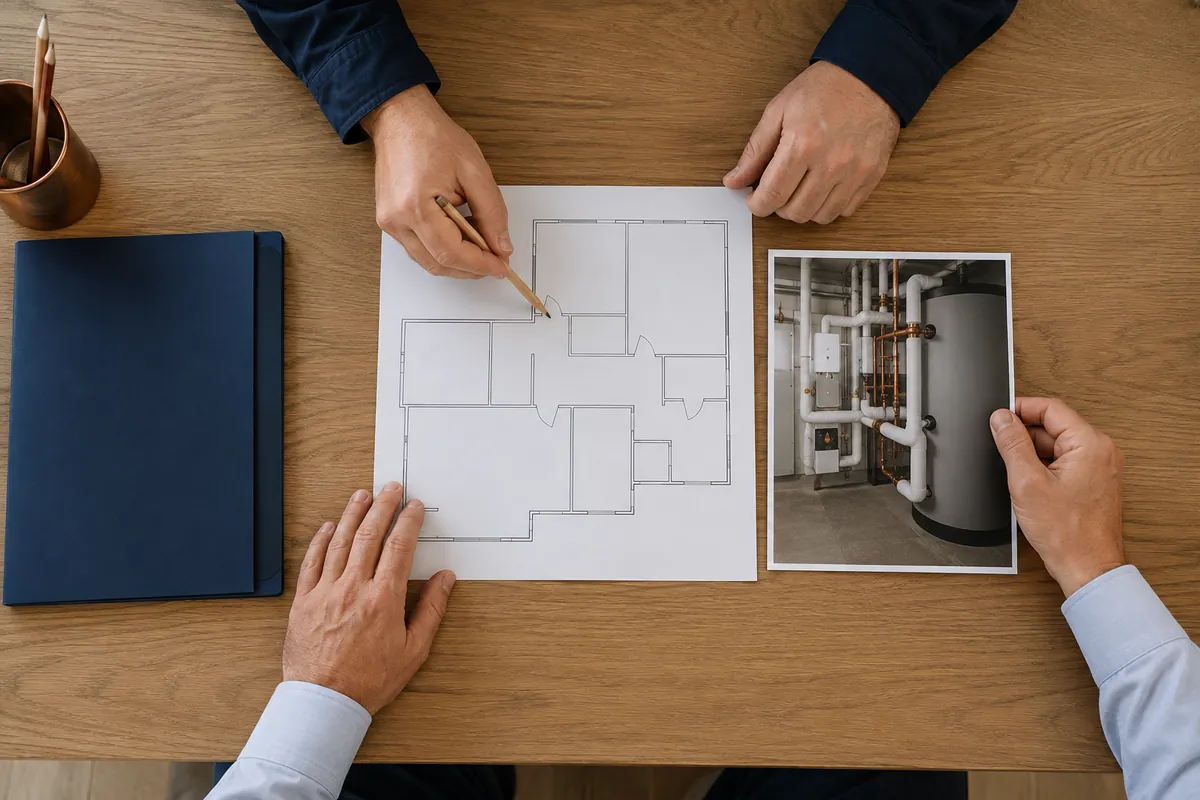
Each option answers a different question, and an active leak still needs repair whichever one is chosen.
Replacement removes the failing pipe. Lining coats the inside of it. Water treatment tries to slow corrosion. Sensors and shutoff are designed to limit the damage when a pipe fails. Only replacement changes the pipe itself. BC Housing says preventative measures such as inspections and water sensors can reduce the risk of water damage, though leaks may still occur. Water sensors monitor the presence of water on surfaces and automatic shutoff devices turn off the supply if a leak is detected, so they respond to escaped water rather than to its cause.
BC Housing, a British Columbia government agency, says the best technique for dealing with a failing plumbing system is to re-pipe, an expensive and disruptive solution for an occupied building. The alternatives are aimed at that cost and disruption. They do not do the same job, and each has conditions under which it stops being suitable.
The four options compared.
The table summarizes what the sources cited on this page say. Each option is discussed below.
| Option | What it does | Where it suits | Limits public sources describe |
|---|---|---|---|
| Repipe (replace) | Replaces failing pipe with new pipe. | A failing plumbing system. | Expensive and disruptive in an occupied building. Concealed risers mean removing finishes and possibly tiles, appliances and cabinetry. |
| Epoxy lining | Coats the inside of existing metal pipe with a barrier. | Aging yet structurally sound pipes. | For one product listing (ICC-ES), all leaks must be repaired before coating and the product is not for gasket connections, valves or flexible pressure pipe. BC Housing says lined pipework should not be exposed to temperatures above 60 °C or pressure above 150 psi, and that epoxy relining is not suitable for plastic pipework systems. |
| Corrosion-control treatment | Adds an inhibitor to the water, intended to slow corrosion. | Prevention; BC Housing says a mineral water management system may not be effective when overall pipe condition is poor. | Success depends on water quality and conditions, and needs monitoring for at least 18 months. May not be effective when overall pipe condition is poor. |
| Sensors and shutoff | Detects escaped water and can close a valve. | Reducing the risk of damage while another option is decided. | Leaks may still occur. |
Replacing the pipe.
A building-science consultant writing for the Canadian Condominium Institute says that replacing the piping means removing interior finishes and possibly tiles, appliances and cabinetry to reach it, and that no building seems to be designed with easy access for piping replacement in mind. BC Housing adds that non-metallic pipework introduces a combustible material into non-combustible construction, and that where it penetrates a fire-resistant separation the detailing can become difficult and expensive.
In Alberta, a plumbing permit is required to install, alter or add to a plumbing system. In Edmonton, the City lists apartments and condos under its plumbing and gas permit for new buildings and changes to existing buildings, and applicants must hold a City business licence and be a certified plumber or gas fitter registered with the City. The applicant is therefore normally the plumbing contractor rather than the board, and the board should confirm that with the City. The City says failure to complete required inspections may mean removing finished walls, and additional inspection costs and delays.
The City defines maintenance as the like-for-like repair or replacement of worn or damaged building components or systems, for their preservation or upkeep but not their improvement, renovation, remodel or upgrade. Its page does not say whether replacing a building’s water piping counts as maintenance or as an alteration, so the contractor should confirm with the City before the work is priced. A permit is not a warranty: Alberta’s Permit Regulation says a permit does not make or imply any assurance about the life expectancy, durability, operating performance or workmanship of the work.
Older buildings add steps. Alberta’s Occupational Health and Safety Code requires that when a building is being altered or renovated, materials in the work area that could release asbestos fibres are encapsulated, enclosed or removed, and that a Director be notified at least 72 hours before activities that may release asbestos fibres. Access to suites is also regulated. The Condominium Property Act limits entry into a unit without the owner’s consent under its easement provisions: notice must be served at least 24 hours before, with entry between 8 a.m. and 8 p.m., unless there are reasonable grounds to believe an emergency requires entry. Legal advice should confirm how that applies to a repipe. EPCOR says home renovations and repairing water leaks may also require its shut-off valve to be turned off, which the utility company can do. A building should ask EPCOR how that applies to a multi-unit property.
No independent Alberta cost or duration figures were found in the research for this guide, so none are given here. The sources describe steps that add work: removing interior finishes, asbestos controls where materials in the area of an alteration or renovation could release asbestos fibres, and, according to BC Housing, detailing where non-metallic pipework penetrates a fire-resistant separation, which can become difficult and expensive. The City says failure to complete required inspections may result in additional inspection costs and delays.
Lining the pipe.
Epoxy lining is a barrier coating applied to the inside of existing pipe. ASTM F2831 covers an epoxy barrier coating applied to the interior of metallic pressurized piping for corrosion protection and to improve flow. BC Housing describes the process as surveying and mapping the building’s pipes to plan the lining into manageable sections, which usually requires additional isolation valves.
The conditions are strict. A product listing published by ICC Evaluation Service says all leaks must be repaired before coating, that the system is not for gasket connections, valves or flexible pressure pipe, and that later additions must be made with mechanical fittings and not with flame or heat. BC Housing says the pipework should not be exposed to temperatures above 60 °C or pressure above 150 psi, and that epoxy relining is not suitable for plastic pipework. The same listing shows that health-effects certification is product-specific, and Health Canada recommends drinking water materials certified to the applicable NSF/ANSI standards.
Outcomes are debated. BC Housing says lined pipes generally come with a limited warranty against leaks, pressure failures and delamination under normal operating conditions. A building-science consultant writing for the Canadian Condominium Institute reports that condominiums can start to see failure of the epoxy system within 5 years of installation, a far cry from the 20-plus year warranty promised, that there was no practical way to review the adequacy of the surface preparation before coating, and that it is not possible to solder to epoxy-lined pipe. That is one practitioner’s experience, not a study.
On the code, BC Housing said in 2016 that neither epoxy relining nor a mineral water management system was covered by the then-current (2012) British Columbia Plumbing Code, that their application fell to the authority having jurisdiction, and that it should be consulted before proceeding. In the research for this guide, no Alberta or City of Edmonton statement on epoxy lining was found. An Alberta building should ask the City and its engineer what documentation is expected.
Treating the water.
Corrosion control ranges from system-wide programs run by a water utility to localized programs implemented by a building owner, according to Health Canada. Health Canada recommends choosing drinking water additives, such as corrosion inhibitors, that are certified as conforming to the applicable NSF/ANSI health-based performance standard or equivalent. Health Canada’s cautions concern using corrosion inhibitors to control lead, copper or iron levels in drinking water rather than pinhole leaks, but they are plain: the successful use of corrosion inhibitors is very much based on trial and error and depends on the water quality and conditions, effectiveness depends largely on maintaining an inhibitor residual and on pH and alkalinity, and pilot studies should be done to determine effectiveness.
For silicate specifically, the independent evidence is limited. Health Canada says the use of sodium silicate alone has not been shown conclusively in the literature to reduce lead or copper concentrations, and that in one study its performance was affected by pH. The United States Environmental Protection Agency says silicate-based inhibitors have been shown to reduce lead and copper levels in first-draw samples at the tap, but their full-scale use has been limited. A Virginia Tech dissertation reports that phosphate and silica inhibitors at sufficient dosages may completely stop pitting, but at very low dosages may accelerate pinhole failures.
Treatment aims to prevent or slow corrosion; it does not repair pipe that is already damaged. A 2017 peer-reviewed review says localized corrosion is typically detected when the pipe is already perforated and leaking, at which point the only solution is to replace the pipe, so prevention is preferred. BC Housing’s building-scale description of mineral dosing, which injects minerals as cold water enters the building, says it may not be effective when overall pipe condition is poor and typically comes with no warranty against leaks or pressure failures, and that service contracts are available for the equipment and minerals. It also says thermal imaging of the pipes may be needed before installation to identify problem areas to replace.
Edmonton’s water already contains orthophosphate, added by EPCOR starting in March 2023, so a building-level program would need to be assessed against water that has been treated at the plant. See Edmonton’s water and your building’s copper pipes.
LEaC Shield, whose installation ProShield coordinates with qualified plumbing and electrical contractors, is in this category. Its own service page describes a managed program that adds controlled amounts of sodium silicate to the water, with ongoing service provided by LEaC Shield under a separate agreement. ProShield’s own guidance is that suitability is assessed building by building, that an active leak still needs repair, and that treatment should not be presented as repairing an existing hole or making all replacement unnecessary.
Sensors and shutoff.
Sensors and automatic shutoff reduce the consequence of a failure; they do not prevent it. BC Housing says inspections and water sensors can reduce the risk of water damage, but leaks may still occur. It describes water sensors as devices that monitor the presence of water on surfaces, and says automatic shutoff devices turn off the water supply if a leak is detected but must be installed on a building’s water main.
Standards exist. ANSI/CAN/IAPMO Z1349 is both an American National Standard and a National Standard of Canada for devices that detect, monitor or control water supply and distribution systems in commercial and residential applications. Its functions include automatic shut-off or alarm notification when conditions indicate a leak. The National Plumbing Code of Canada 2020, which Alberta lists as in force from April 1, 2023, requires that, in residential buildings with more than one dwelling unit, a shut-off valve be installed where the water supply enters each dwelling unit. Ask the City how that applies to an existing building. The Insurance Bureau of Canada’s 2020 task force midterm report recommended automatic water shut-off valves, moisture sensors and leak detection devices to help mitigate risk and reduce the severity of damage within condominium/strata buildings. That is a recommendation, not a code requirement.
The sources found did not say whether installing an automatic shutoff valve needs an Alberta plumbing permit; the Permit Regulation exempts changing a valve where no design change to the piping is needed. Ask the City and the plumber. BC Housing notes that buildings with low water-related claims and a proven maintenance history are a lower risk for insurers. See leak sensors and automatic shutoff planning and corrosion control versus leak sensors.
How to decide: evidence first.
Each option is defensible for some buildings and wrong for others. Evidence is what separates them.
- Map the leak history by system. BC Housing says domestic hot water recirculation pipes are generally the first to leak, followed by space-heating hot water pipes, then cold water pipes, because constant flow and high temperatures speed up corrosion. Compare that pattern with the building’s own.
- Send failed pipe sections to a laboratory. A research study of a community’s pinhole-leak problem combined analysis of failed pipes, a survey of where and how the pitting occurred, including hot versus cold water, and an examination of water chemistry. EPA researchers say the exact cause of copper pitting, and the solution, are often unknown, and a 2017 review says pitting on copper premise plumbing cannot yet be accurately predicted.
- Read water tests carefully. Health Canada says there is no single, reliable index or method to measure water corrosivity and reflect population exposure to contaminants released by the distribution system, and the EPA says the Langelier index has no value as a corrosivity indicator for lead and copper.
- Do not assume the reserve fund study examined the pipes. The regulation requires an on-site visual inspection of visible components and a review of documents. Concealed piping needs its own investigation. The Condominium Property Act lists, among uses of the reserve fund, a report prepared by an expert examining the condition of the corporation’s property and the common property.
- Ask for more than one proposal, and put the same questions to every provider.
Questions to ask any provider, ProShield included.
These questions apply to a plumber, a lining contractor, a treatment provider or a sensor supplier.
- What evidence shows this option suits our pipes: pipe samples, water tests, leak history, an engineer’s report?
- What exactly is included, and what is excluded?
- What happens if a leak occurs afterward: who repairs it, who pays for the damage, and what does the warranty exclude?
- What are the ongoing obligations and costs, and who performs them?
- Who holds the permit and requests the inspections, and how are they documented?
- How will suite access be coordinated, and how long will each suite be affected?
- Can we speak with owners in buildings of similar age and water that used this approach, and what did they find after several years?
Where ProShield fits.
ProShield does not repipe or line piping; those are plumbing and lining trades. ProShield investigates leaks, documents what it finds, coordinates LEaC Shield assessments and installations with qualified trades, and plans sensors and shutoff. If the evidence points to replacement, the honest recommendation is replacement. See pipe condition assessment for condominiums for how to gather that evidence, and the board guide to water protection proposals for comparing offers.
Sources and further reading
- BC Housing: Maintenance Matters 21, preventing water leaks (2018)
- BC Housing: Builder Insight 16, alternatives to domestic water re-piping (2016)
- Canadian Condominium Institute (Golden Horseshoe): Epoxy pipe lining, a retrospective (2024)
- Virginia Tech: Impact of an epoxy pipe lining material on distribution system water quality (2009)
- ICC Evaluation Service: PMG-1057 listing for an epoxy flow-lining system (2026)
- Vargas et al.: Copper corrosion and biocorrosion events in premise plumbing, Materials (2017)
- Health Canada: Guidance on controlling corrosion in drinking water distribution systems (2025)
- Alberta Permit Regulation (Alta Reg 204/2007)
- City of Edmonton: Plumbing and gas permits, commercial and multi-unit
- Alberta Occupational Health and Safety Code (Alta Reg 191/2021)
- Alberta Condominium Property Act
- EPCOR: Water shutoff valve
- ASTM International: F2831, internal epoxy barrier coating for metallic pressurized piping (2019)
- US EPA: Optimal corrosion control treatment evaluation, technical recommendations (2016)
- Virginia Tech: Insights into non-uniform copper and brass corrosion in potable water systems, Sarver (2010)
- EPCOR: Orthophosphate in water
- IAPMO: Standard for detection, monitoring and control of plumbing systems (2021)
- Government of Alberta: Plumbing codes and standards
- National Plumbing Code of Canada 2020, Division B (copy hosted by the Regional District of Nanaimo)
- Insurance Bureau of Canada: National Commercial Insurance Task Force midterm report (2020)
- BC Housing: Maintenance Matters 20, managing internal water systems (2018)
- US EPA: Copper pitting and pinhole leak research study, Lytle and Payne (2004)
- US EPA: Copper pitting corrosion and pinhole leaks, a case study, Lytle, Payne and Feldhaus (2005)
- Alberta Condominium Property Regulation (Alta Reg 168/2000)
Questions people ask
Is repiping the only permanent fix?
BC Housing says re-piping is the best technique for dealing with a failing plumbing system, but an expensive and disruptive solution for an occupied building. Lining and mineral water management are alternatives to re-piping, and each has conditions under which it stops being suitable. BC Housing gives temperature, pressure and pipe-material limits for epoxy lining, and says a mineral water management system may not be effective when overall pipe condition is poor.
Does epoxy lining need a permit in Alberta?
The City of Edmonton says a plumbing or gas permit is required when installing or altering plumbing equipment or infrastructure. No Alberta or City of Edmonton statement specifically on epoxy lining was found in the research for this guide, so ask the City and the contractor before work is priced.
Can corrosion control fix pipes that already leak?
No source found says so. A 2017 peer-reviewed review says localized corrosion is typically detected when the pipe is already perforated and leaking, and that prevention is preferred. An active leak still needs repair. Health Canada says water quality parameters should be monitored for at least 18 months after corrosion inhibitors are introduced.
Do we need an engineer?
It depends on the work and the City’s requirements, which the sources found did not settle. The Condominium Property Regulation limits reserve fund study providers to listed qualified individuals, beginning with professional engineers and professional technologists. The Act lists a report by an expert examining the condition of the corporation’s property among the uses of the reserve fund.
How much does it cost, and how long does it take?
No independent Alberta cost or duration figures were found, so this guide gives none. The sources describe steps that add work: removing interior finishes, asbestos controls where materials in the area of an alteration or renovation could release asbestos fibres, and, according to BC Housing, detailing where non-metallic pipework penetrates a fire-resistant separation, which can become difficult and expensive. The City says failure to complete required inspections may result in additional inspection costs and delays. Get written proposals that state scope and exclusions.