
Copper piping
Pinhole leaks in copper pipes: causes, warning signs and what a building can do
A pinhole leak is a small hole that corrosion has worked through the wall of a copper pipe. The hole is small, the damage can be large, and a copper system can have significant pitting damage before it has had a first pinhole leak. This guide explains what causes pinhole leaks, what public research says about water chemistry, temperature and velocity, and what an owner or board can do next.
By ProShield Leak Detection Inc. · Updated
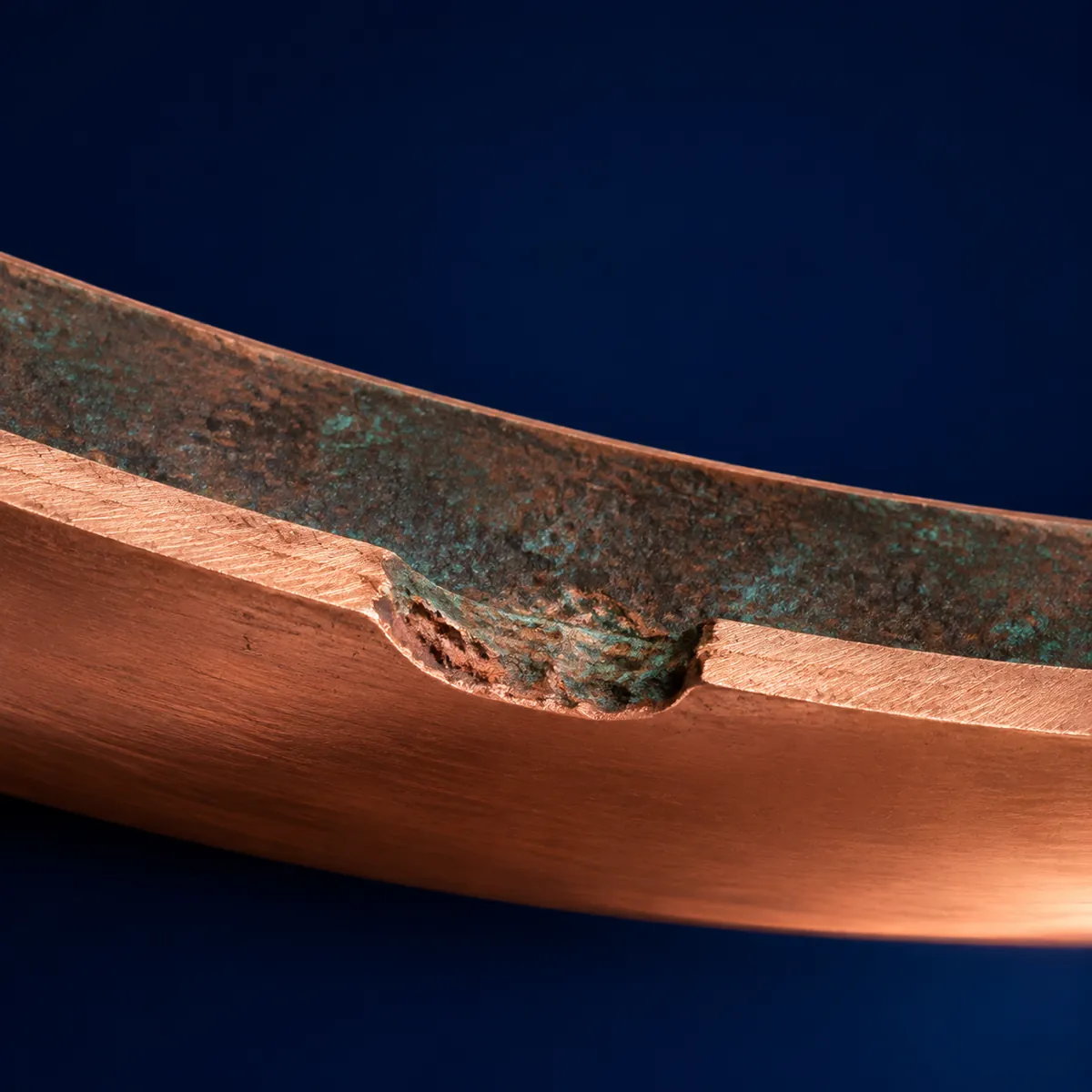
A pinhole is the final breakthrough of progressive pitting corrosion, and the cause can be one factor or several.
A pinhole leak is the perforation of a copper pipe or fitting by pitting corrosion that starts on the inside surface. Health Canada describes the process: at a small area of the surface, copper is oxidized and depleted, forming a pit that can eventually breach the pipe wall.
Research points to several causes that can act alone or together: surface imperfections, carbon left from manufacturing, soldering flux, unfavourable water quality and microbiological activity. In building hot water systems, Health Canada says a water temperature above 60 °C together with high flow velocity is a factor in erosion corrosion. Which cause is at work in a given building has to be established with evidence, not assumed.
One repaired leak is an event. Several in the same building are a pattern, and a pattern is a question about the whole system. Read recurring pinhole leaks in condominiums for how to turn separate incidents into a record a board can act on.
Why pinhole leaks can go unnoticed.
A Maryland task force described a pinhole leak as the final breakthrough of progressive pitting corrosion, and noted that a copper water system can have significant pitting damage without having any pinhole leaks yet. Researchers at the United States Environmental Protection Agency wrote that pinhole-leak problems resulting from extensive pitting are widely under-reported, and that homeowners may not notice the problem because of hidden plumbing or a failure to examine it regularly.
Timing varies. Health Canada says pitting can occur relatively rapidly, in a few months to years after installation, in cold water plumbing, whereas in hot water systems it generally takes many years, typically more than 8 years, to perforate the pipe wall.
Warning signs to record.
A pinhole can go unnoticed because plumbing is hidden or not regularly examined, and undetected leakage can damage walls and ceilings and lead to mould growth. These are the signs worth writing down.
- A blue-green deposit on the outside of a copper pipe or fitting. A county water utility notes that blue-green areas indicate corrosion but not necessarily a pinhole leak. See green stain on copper pipe.
- A ceiling or wall stain that returns after it dries. See repeat ceiling stain in the same spot.
- A water meter that keeps moving with every fixture off. See water meter running with no visible leak.
- Repeated leaks in one riser, one floor or one line, and whether they are on hot or cold water.
What research links to pinhole leaks in copper.
No single cause explains every case: Health Canada lists several factors that can start a pit alone or in combination, and EPA researchers say the exact cause is often unknown. The table lists the causes public sources describe and what each source actually says.
| Cause | What public sources say | Where it tends to show |
|---|---|---|
| Water chemistry | Health Canada says hard, high-alkalinity groundwaters are particularly aggressive toward copper, and that at pH above about 8 copper corrosion problems are almost always associated with non-uniform or pitting corrosion. It calls sulphate a strong corrosion catalyst implicated in pitting. | Cold lines, hot lines or both, depending on the water and the type of pitting |
| Stagnation and water age | A UK review says probably the main cause of most forms of pitting is water stagnation, whether after pressure testing before handover or later in operation. Health Canada says increased water age is associated with loss of disinfectant residual and lower pH. | Places where water stands unused, which is this guide’s reading of the stagnation sources |
| Disinfectant | Health Canada says free chlorine is an important oxidant for copper. Published studies of chlorine and chloramine report different results, and ASPE Pipeline, the publication of the American Society of Plumbing Engineers, notes that the potential for corrosion from chlorine and chloramine depends on water quality. | Whole system |
| Installation and workmanship | Molten soldering flux forced inside a pipe leaves a surface that cannot form protective oxides and becomes more susceptible to pitting. A UK review says excessive flux is often initially blamed for pinhole leaks, but nowadays flux is rarely the cause. The Copper Development Association says a rough, unreamed cut edge can cause erosion-corrosion. | New or recently repaired work |
| Fast-moving water | Health Canada says a water temperature above 60 °C together with high flow velocity is a factor in erosion corrosion in building hot water systems. A UK review says it is usually found in hot water recirculating systems, especially hot water return lines, where leaks can occur in weeks to months. | Hot water recirculation lines |
| Microbiological activity | A UK review says microbially influenced corrosion has been found especially in hospitals and other large buildings with long pipe runs. | Found especially in hospitals and other large buildings with long pipe runs |
| External corrosion | A UK review describes corrosion of copper pipework under phenolic foam insulation in the presence of moisture. | Insulated pipe that stays wet |
Temperature and speed: why hot water lines can fail differently.
The Copper Development Association recommends that designers not exceed water velocities of 8 feet per second for cold water and 5 feet per second in hot water up to approximately 140 °F. It says that, because of constant circulation and elevated water temperatures, particular attention should be paid to water velocities in circulating hot water systems. Hot water recirculation and pipe corrosion explains what that means for a building.
Does Edmonton’s water cause pinhole leaks?
EPCOR publishes Edmonton’s water quality. It says its water has a yearly average pH of 7.8. EPCOR says all of its results are daily averages leaving the water treatment plants, and that numbers in the distribution system may vary. They do not describe the water that has sat in, and been heated inside, a particular building’s pipes. In the research for this guide, no published study linking Edmonton’s water chemistry to pinhole leaks in Edmonton buildings was found.
Edmonton’s water and your building’s copper pipes sets out EPCOR’s published figures beside what Health Canada, the United States Environmental Protection Agency and others say about each one, including EPCOR’s addition of orthophosphate since March 2023, and what a board can and cannot conclude from them.
What to do when a pinhole leak appears.
The first job is to protect people and stop the flow. Then the leak becomes evidence.
- Stay clear of wet electrical equipment. If a labelled valve is safe to use, close it. See burst pipe in a condo.
- Have a qualified plumber repair the pipe. In Alberta, plumbing includes installing, altering, maintaining and repairing piping systems, only listed classes of individuals, such as trade certificate holders and apprentices, may perform restricted activities in the plumber trade, and a plumbing permit is required to install, alter or add to a plumbing system. Whether a particular repair needs a permit depends on the work, so the plumber should confirm with the City.
- Keep the failed section of pipe and photograph it before it is removed. The pipe itself is evidence of what happened.
- Log the leak: the date, suite, floor or riser, hot or cold line, where on the pipe it failed and what the plumber found.
When it is a pattern, the options depend on the cause.
Options range from repairing each failure to treating the water, lining the pipe or replacing it, with sensors and automatic shutoff, which can help limit the damage while a decision is made. Repipe, line or treat compares them.
Independent sources are cautious about corrosion-control chemistry. Health Canada says adjusting pH at the treatment plant is the most common method used to reduce corrosion in drinking water distribution systems. It says the effectiveness of corrosion inhibitors depends largely on maintaining an inhibitor residual and on the pH and alkalinity of the water, and that only limited data are available on the impact of sodium silicate on copper solubility. A Virginia Tech dissertation reports that at sufficient dosages phosphate and silica inhibitors may completely stop pitting, but at very low dosages they may accelerate pinhole failures.
Because damage can be advanced before the first leak, a treatment program should be judged by monitoring over time, not assumed to undo existing damage, and an active leak still needs repair.
Where ProShield fits.
ProShield does not repair or replace piping. It investigates leaks, documents what it finds, and helps buildings plan protection. For recurring pinhole leaks in a domestic hot and cold water system, a LEaC Shield assessment reviews the building’s history and records to decide whether a corrosion-control program is suitable. For a leak that cannot be found, see water leak detection.
Sources and further reading
- State of Maryland: Final report of the Task Force to Study Pinhole Leaks in Copper Plumbing (2004)
- Health Canada: Guidelines for Canadian Drinking Water Quality, technical document on copper (2019)
- US EPA: Copper pitting and pinhole leak research study, Lytle and Payne (2004)
- Butler County (Ohio) Water and Sewer Department: Pinhole leaks
- US EPA: Copper pitting corrosion and pinhole leaks, a case study, Lytle, Payne and Feldhaus (2005)
- Foundation for Water Research (UK): Causes of copper corrosion in plumbing systems (2017)
- Virginia Tech: Examining aspects of copper and brass corrosion in drinking water, Murray-Ramos (2006)
- Virginia Tech: Investigation of copper pitting propensity using bench and field scale testing, Sheffer (2006)
- ASPE Pipeline: Plumbing design for success, understanding and preventing copper corrosion (2021)
- Copper Development Association: Copper Tube Handbook (2026)
- EPCOR: Edmonton daily water quality
- EPCOR: Orthophosphate in water
- Alberta Designated Trades and Restricted Activities Regulation (Alta Reg 161/2022)
- Alberta Permit Regulation (Alta Reg 204/2007)
- BC Housing: Maintenance Matters 21, preventing water leaks (2018)
- Virginia Tech: Insights into non-uniform copper and brass corrosion in potable water systems, Sarver (2010)
- US EPA: Optimal corrosion control treatment evaluation, technical recommendations (2016)
- EPCOR: Edmonton waterworks annual report, 2025
Questions people ask
What causes pinhole leaks in copper pipes?
Pitting corrosion that starts inside the pipe. Health Canada lists surface imperfections, carbon residues from manufacturing, soldering flux, unfavourable water quality and microbiological activity as factors that could, alone or in combination, start a pit.
How long does it take a copper pipe to develop a pinhole leak?
It varies. Health Canada says pitting can occur in a few months to years after installation in cold water plumbing, while in hot water systems it generally takes many years, typically more than 8 years, to perforate pipe walls.
Is a blue-green stain always a pinhole leak?
No. A county water utility says blue-green areas on copper pipes indicate corrosion but not necessarily a pinhole leak. The stain is a reason to look closely, not a diagnosis.
Does hard water cause pinhole leaks?
Health Canada says hard, high-alkalinity groundwaters are particularly aggressive toward copper. The United States Environmental Protection Agency says calcium carbonate films only rarely form on lead and copper pipe and are not considered an effective form of corrosion control. EPCOR’s 2025 report gives a mean total hardness of 173.9 mg/L as calcium carbonate for Edmonton’s drinking water at the water treatment plants, but a citywide figure does not diagnose an individual building.
Can pinhole leaks be prevented?
Prevention depends on the cause. Utilities adjust pH to reduce corrosion, and the Copper Development Association recommends that designers not exceed set flow velocities, says that a rough inside edge not removed by reaming may cause erosion-corrosion, and says that workmanship leaving excessive flux inside the tube can cause or intensify pitting. Inside a building, a corrosion-control program is one option, and it has to be assessed for that building.