Finding leaks
How hidden pipe leaks are found in a building
A hidden leak is found by narrowing, from a symptom to a system, to a section of pipe, to a point. Methods differ in what they can tell you: the EPA cautions that not all leak-detection techniques can determine where a leak is, and even fewer can assess its magnitude, so a careful investigation combines methods. Each method answers part of the question and has limits that public guidance states plainly. This guide explains the main methods and how they fit together, so an owner or board can tell a careful investigation from a guess.
By ProShield Leak Detection Inc. · Updated
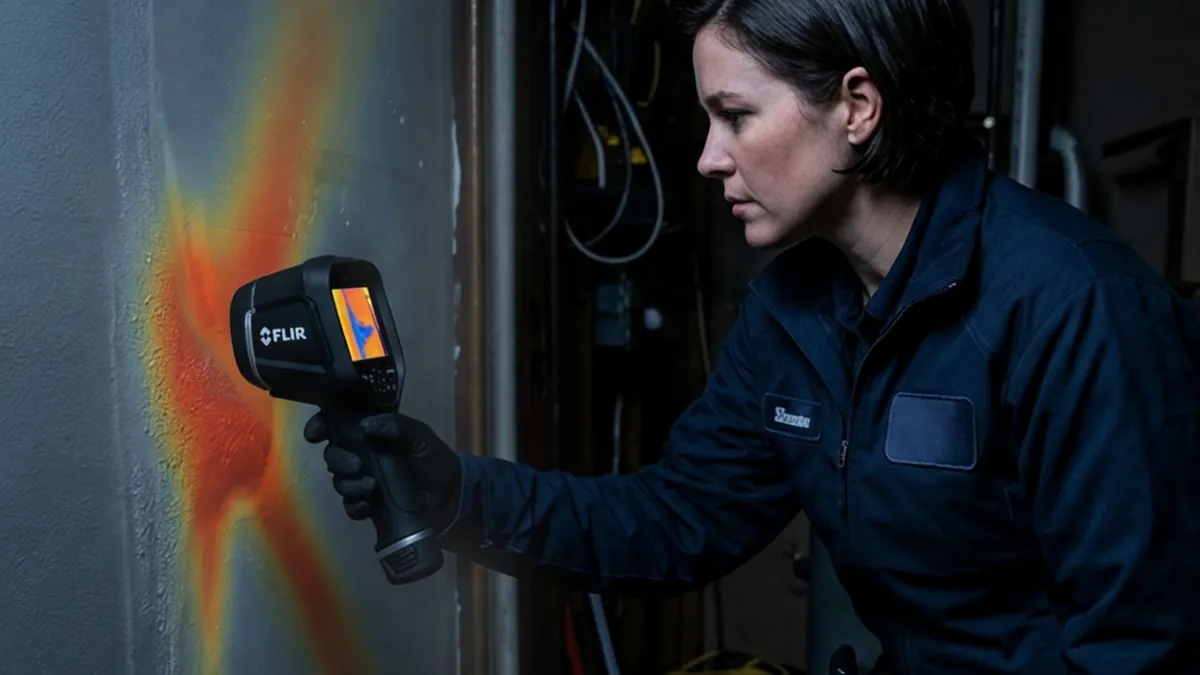
A hidden leak is found by narrowing, and each step has its own tool.
This guide takes the methods in the order an investigation can follow: records and symptoms, a check of the water meter, moisture mapping and thermal imaging of the affected area, acoustic listening on the pipe, and, where needed, a pressure or tracer-gas test of an isolated section. A small, controlled opening can then let an investigator inspect the likely point. No single reading is a finding by itself.
The United States Environmental Protection Agency cautions that not all leak-detection techniques can determine where a leak is located, and even fewer can assess how large it is. A careful investigation says which of those questions each finding answers.
In the research for this guide, most public guidance found was written for water utilities and buried service lines. The distances, pressures and ranges in that guidance are not building figures, and it should be read with that in mind.
The methods at a glance.
What each method can tell an investigator, and what it cannot.
| Method | What it can show | What it cannot show |
|---|---|---|
| Water meter check | Whether water is leaving the system when nothing should be using it. | Where the leak is. Smart meters cannot locate leaks, only help determine whether one exists. |
| Moisture meter | Whether a material reads wetter than a dry reference nearby. | Whether the water is a leak, condensation or an old event. Readings on non-wood materials are on a relative scale. |
| Thermal imaging | Where a surface is cooler or warmer than expected. | Why, or how large the leak is. It needs a temperature difference between air and water. |
| Acoustic listening | Where along an accessible pipe the noise of a leak is loudest. | A leak in a pipe that does not carry sound well. Leak noise in plastic pipe travels poorly. |
| Tracer gas | Whether an isolated line leaks, whatever the pipe material. | Precisely where. Gas methods detect existence better than location. |
| Pressure test | Whether an isolated section holds pressure. | Where the leak is within the section. |
| Borescope | What is inside a cavity, through a small hole. | Anything outside the small area it views. |
Start with what the building already knows.
The leak log, the timing of symptoms, whether the water is hot or cold, and recent plumbing work can help narrow the search before any instrument is used. Knowing which pipe system is leaking narrows it further. ProShield distinguishes an observation, an indication, a likely source and a confirmed source, so that the next decision is not built on a stronger claim than the evidence supports. See about ProShield.
The water meter: is water leaving the system at all?
The United States EPA’s WaterSense program suggests reading the meter before and after a two-hour period when no water is being used; if the meter changes at all, there is probably a leak. EPCOR’s guidance for homes says that if the flow indicator is moving while everything that uses water in the house is turned off, there is a leak somewhere. A United States Department of Energy laboratory adds that if water use never reaches zero at a facility with no continuous end-uses, a leak is likely, and that night-time use in a facility without 24-hour operation may also indicate one.
In a building with many suites, a meter reading is only meaningful if all deliberate use downstream can be accounted for. A meter can help show whether water is leaving the system, but not where. The Department of Energy makes the same point about smart meters, which cannot locate leaks but can help water managers determine whether one exists.
Moisture meters: is the material wet?
A moisture meter typically has a thin probe that can be inserted into the material or pressed against its surface, and the EPA lists carpet, wallboard, wood, brick and concrete among the materials it can be used on. Meter makers describe two main types: pin meters, which penetrate the material, and pinless meters, which read with electromagnetic waves. One maker says a pin meter measures only the material between its pins, so a moisture pocket outside that area can go undetected. Another says pinless readings are helpful for quickly finding moisture but should be confirmed with a pin meter, and that a pinless meter might detect metal behind the surface.
Readings on drywall or masonry are relative, not a true moisture content. They are most useful as a map: which areas are wetter than a dry reference on the same wall.
Thermal imaging: where is the surface cooler or warmer?
Handheld thermal cameras detect water leaks in or around walls. The United States Department of Energy’s Federal Energy Management Program says that, assuming an average water temperature of 40 to 70 °F, leaks are typically warmer than their surroundings in winter and cooler in summer. A building-science article says water leaks often show up as cooler areas, from cold water, the cooling effect of evaporating water and water’s thermal mass.
The method has limits. A Department of Energy laboratory lists a required 20 °F difference between ambient air and the water temperature, and no indication of the leak’s size. Writing about leaks in buried water systems, the EPA says infrared locating is most frequently used together with other methods of detection, to better locate the best potential excavation sites. A thermography vendor’s paper says that to find a pipe leak in a wall or under a slab a temperature difference generally has to be induced by running hot water through the pipe, and that locating moisture is often simple but determining its source can be difficult, with condensation rather than leakage often the culprit. A thermal image shows where something is wet or cold, not why.
Acoustic listening: can the noise of the leak be heard?
Acoustic equipment detects a leak through the noise water makes as it escapes from the pipe. The EPA says the pressure difference driving water out of a pipe must usually exceed 15 psi for substantial audible waves to be generated. Tools range from handheld listening sticks, which require no modification to the pipe but can only be used on accessible pipes and need training, to hydrophones that pick up leak sounds when placed on the piping, to loggers left in place to record over time. Loggers are scheduled to run during low-use hours to minimize acoustic interference, and PVC pipe needs longer recording with sensors placed closer together. A correlator uses sound received at two contact points on either side of a leak, plus the pipe material and diameter, to calculate the leak’s position.
Pipe material matters. The EPA says leak sounds in non-metallic pipe do not travel well through the pipe. Its table of leak-noise travel distances for buried service lines, for a 2 gallon-per-minute leak at 50 psi, gives 600 to 1,000 feet in copper tubing and 800 to 1,200 feet in galvanized steel, but only 50 to 100 feet in plastic tubing. Those are figures for buried lines, not in-wall ranges, but the direction is the point: plastic hides sound. The EPA, writing about water distribution systems, says each system has its own acoustic signature that changes from one point to another, and that an experienced operator with knowledge of the system is a key factor in effective leak detection.
Tracer gas: another way to test a line.
Tracer-gas detection injects an inert gas, typically a mixture of 5% hydrogen in nitrogen, into the pipe being tested and uses sensors to detect hydrogen where it escapes to the surface. The EPA lists its strengths as not depending on pipe material, water pressure or the shape of the leak, and working on operating or dewatered lines, with dewatered lines giving greater sensitivity. It also says gas methods are more accurate at detecting that a leak exists than where it is, because the escaped gas may take multiple paths to the surface, and that the technique is used less often on active pipelines that must be dewatered.
A hydrogen-instrument manufacturer says the standard mix of 5% hydrogen and 95% nitrogen is classified as non-flammable, and a gas supplier says hydrogen is non-toxic and non-corrosive. Both are commercial sources. Tracer gas is a further method, and like the others it is one piece of evidence, not a verdict.
Pressure tests: is this section tight?
The National Plumbing Code of Canada 2020 requires a water pressure test of a potable water system section after it is completed and before it is placed in operation, except that an air pressure test may be used in freezing conditions. and allows the test to be applied to each section or to the whole system. The system must withstand a water pressure at least equal to its maximum in-service pressure, or an air pressure of not less than 700 kPa for at least 2 hours without a drop.
Those tests apply to a section after it is completed and before it is placed in operation. A similar test on an existing section, isolating it and watching for a drop in pressure, may indicate whether the section holds pressure, though not where it leaks; that is this guide’s explanation, not a code requirement. In the research for this guide, no Alberta rule for periodic pressure testing of existing building piping was found.
Small openings and cameras: seeing the cavity.
The EPA defines a borescope as an optical probe, inserted through a small hole drilled into a wall, that lets an investigator inspect a small portion of the wall without causing extensive damage. Once the methods above have located a likely point, a small opening lets an investigator inspect it without extensive damage before any larger repair is planned.
What to do before anyone arrives.
These steps help preserve evidence and need no special equipment.
- Note the meter reading and the time, and check whether it moves with everything off.
- Record where and when water appears, and whether the line is hot or cold.
- Photograph stains and damp areas from a safe position, and mark their edges with a date.
- Keep the affected rooms, the mechanical room and the riser closets accessible.
- Do not open walls to look. It can disturb evidence and spread damage, whereas a small controlled opening by an investigator, for example for a borescope, lets part of the wall be inspected without extensive damage. See find a condo leak without opening walls.
Where ProShield fits.
Investigating hidden leaks is ProShield’s work. It uses the methods that suit the building, typically records, moisture readings, thermal imaging and acoustic methods, and treats each reading as evidence rather than a diagnosis. It documents what each finding does and does not show and identifies the clearest repair, access or monitoring next step. It does not repair the pipe. See water leak detection and thermal versus acoustic leak detection, and call for emergency water response if water is active.
Sources and further reading
- US EPA: Control and mitigation of drinking water losses in distribution systems (2010)
- US EPA WaterSense: Fix a Leak Week
- EPCOR: How to read your meter
- US Department of Energy FEMP: Distribution system leak detection
- Building Science Corporation: How to look at a house like a building scientist, part 4, water (2021)
- Pacific Northwest National Laboratory: Overview of available leak detection technologies (2019)
- National Plumbing Code of Canada 2020, Division B (copy hosted by the Regional District of Nanaimo)
- US EPA: Mold course chapter 3, investigating moisture and mold problems
- Delmhorst: Pin or pinless moisture meters (a meter manufacturer)
- Protimeter: Pinless versus pin moisture meters (a meter manufacturer)
- Snell Infrared: Nondestructive testing of building envelope systems using infrared thermography (a thermography vendor)
- Sensistor Technologies: Hydrogen as tracer gas for leak testing (2006, an instrument manufacturer)
- Air Products (UK): Leak detection gas (an industrial gas supplier)
Questions people ask
Can a leak be found without opening walls?
Non-invasive methods can help narrow the source before walls are opened, but not every method gives both location and size. The EPA cautions that not all leak-detection techniques can determine where a leak is, and even fewer can assess its magnitude. A small controlled opening, for example for a borescope, lets an investigator inspect part of the wall without causing extensive damage.
Does thermal imaging find every leak?
No. A Department of Energy laboratory lists a required 20 °F difference between ambient air and the water temperature, and no indication of leak size. A vendor paper adds that condensation rather than leakage is often the source of the moisture that thermography finds.
Can leaks in plastic pipe be heard?
With more difficulty. The EPA says leak sounds in non-metallic pipe do not travel well through the pipe, and a Department of Energy laboratory says PVC pipe needs longer recording and sensors placed closer together.
Is tracer gas safe to use in a building?
The standard mix is 5% hydrogen and 95% nitrogen, which a manufacturer says is classified as non-flammable. A gas supplier says hydrogen is non-toxic and non-corrosive. The contractor’s procedures and the building’s access rules still apply.
How can I tell from the water meter whether there is a leak?
The EPA’s WaterSense program suggests checking the meter before and after two hours when no water is being used; if it changes at all, there is probably a leak. EPCOR’s guidance for homes says a moving flow indicator with everything that uses water in the house turned off means a leak somewhere.