
Edmonton water
Edmonton’s water and copper pipes: what EPCOR’s figures tell a building
EPCOR publishes detailed figures for the water it delivers in Edmonton, and it began adding orthophosphate for corrosion control in March 2023. Owners and boards often ask whether that water explains their copper pipe leaks. This guide sets the published figures beside what public sources say about each one, and is plain about what a citywide number cannot show about a single building.
By ProShield Leak Detection Inc. · Updated
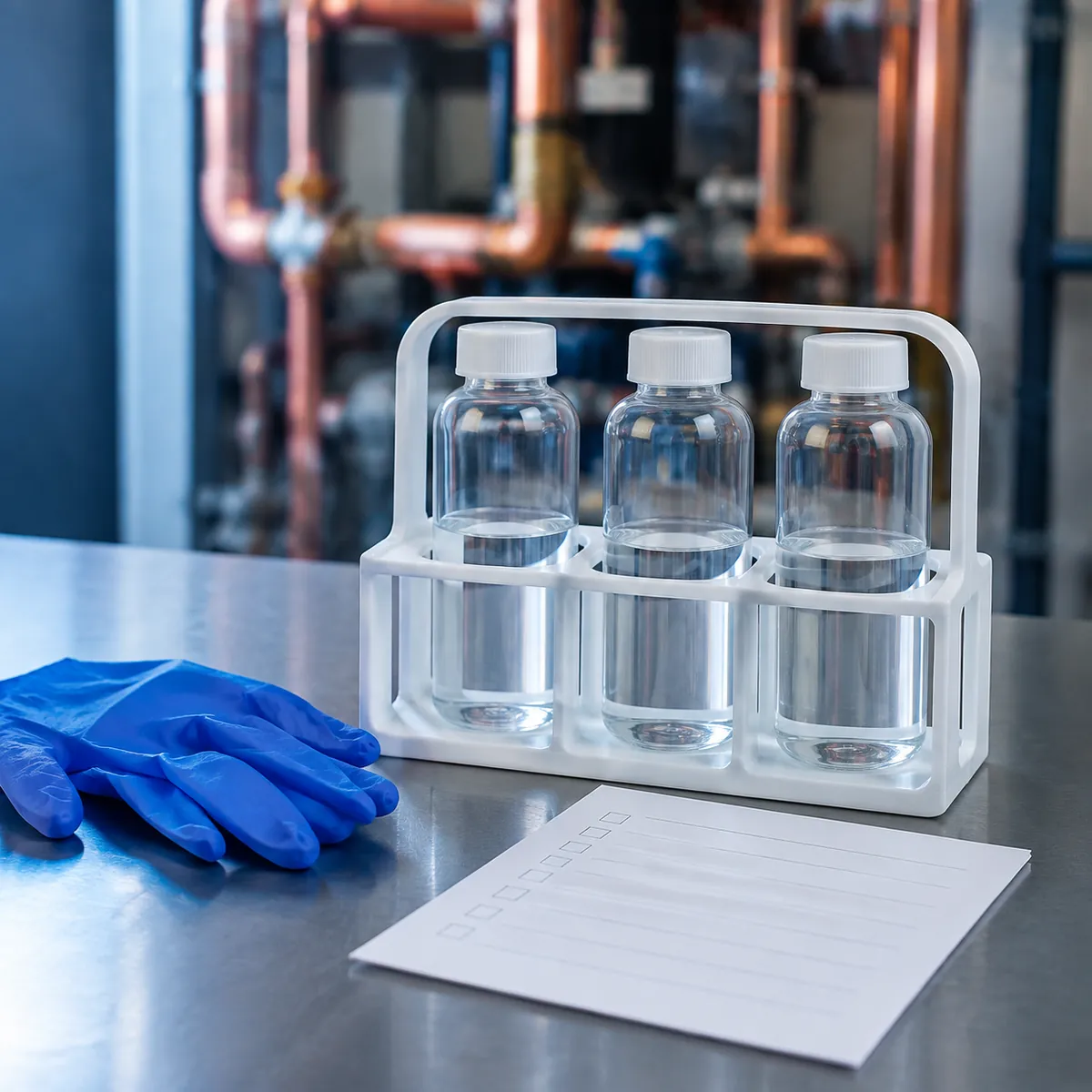
The figures describe treated water, not the water inside your pipes.
Edmonton’s water begins in the glaciers, snowpack and ground water of the Canadian Rockies, flows into the North Saskatchewan River and is treated at EPCOR’s E.L. Smith and Rossdale plants. EPCOR says E.L. Smith primarily supplies the northwest, west, southwest and university areas and Rossdale the downtown, east, northeast and southeast, with a large crossover region that either plant can supply.
EPCOR says its published results are daily averages leaving the water treatment plants, and that numbers in the distribution system may vary. Once water reaches a building it can stand in pipes, circulate through a hot water loop and pass through a softener, and public sources tie each of those to copper corrosion. A citywide figure cannot be turned into a diagnosis of one building. In the research for this guide, no published study linking Edmonton’s water chemistry to pinhole leaks in Edmonton buildings was found.
EPCOR’s published figures, and what public sources say about copper.
The figures below are EPCOR’s. The right-hand column reports what public sources, including Health Canada, the US EPA and EPCOR itself, say about the same measure, without drawing a conclusion for Edmonton.
| Measure | What EPCOR publishes | What public sources say about copper |
|---|---|---|
| pH | A yearly average of 7.8. EPCOR says pipe corrosion may become significant in its water at pH below 7.5, and scaling problems increase above 8.5. | Health Canada says copper corrosion increases rapidly as pH drops below 6, and that above about pH 8 copper corrosion problems are almost always pitting. |
| Alkalinity | A 2025 mean of 115.9 mg/L as calcium carbonate, ranging from 81.0 to 140.0. | Health Canada says hard, high-alkalinity groundwaters are particularly aggressive toward copper, and that low alkalinity (below 25 mg/L) has also proved problematic. EPCOR says moderate alkalinity helps minimize corrosion. |
| Hardness | A 2025 mean of 173.9 mg/L as calcium carbonate, ranging from 131.0 to 212.0. | The United States Environmental Protection Agency says calcium carbonate films only rarely form on lead and copper pipe and are not considered an effective form of corrosion control. |
| Chloride and sulphate | A 2025 mean of 6.36 mg/L chloride and 71.3 mg/L sulphate. | Health Canada says chloride, traditionally reported as aggressive towards copper, has been found less detrimental for cuprosolvency (copper release into the water) than originally expected, and that sulphate is a strong corrosion catalyst implicated in copper pitting. |
| Disinfectant | Total residual chlorine is composed entirely of chloramine. | Published studies of chlorine and chloramine reach different conclusions for different waters. |
| Orthophosphate | Added since March 2023 at approximately 0.9 mg/L as phosphorus. | Health Canada says orthophosphate is generally used for lead control, and that its effects on copper are secondary considerations. |
What orthophosphate is for, and what is known about copper.
EPCOR says orthophosphate forms a protective coating inside water lines and household plumbing, and that it is a proven treatment method and industry standard to prevent corrosion and reduce lead in drinking water. Edmonton City Council and administration approved the addition in March 2019, and EPCOR added it starting in March 2023. The phosphoric acid used is certified to the standard NSF/ANSI/CAN 60.
For copper, the published evidence is mixed, and the dose matters. Health Canada reports that some authors found orthophosphate may reduce copper levels in the short term but may prevent more stable scales forming in the long term. WSSC, a Maryland water utility, said about 5,200 customers had reported leaks to its database and that reports then declined to about 200 in 2004 and six in 2010, after it began adding orthophosphate in late 2003. That is the utility’s own tally, not a controlled study, and the quote does not say over what period the first figure was counted. A Virginia Tech dissertation reports that phosphate at sufficient dosage may completely stop pitting, while at very low dosage it may accelerate pinhole failures.
The research for this guide found no published study of whether EPCOR’s orthophosphate dose has changed pinhole behaviour in Edmonton buildings. A building whose leak frequency has changed since March 2023 should say so in its leak log, with dates, so the change can be examined rather than assumed.
What a citywide figure cannot show.
Several things that matter to copper are decided inside the building.
- Stagnation. A UK review says probably the main cause of most of the forms of pitting it describes is water stagnation, before handover or later in operation. Vacant suites and rarely used branches are where water sits.
- Water age. Health Canada says increased water age is associated with loss of disinfectant residual and lower pH, and could increase the propensity of water toward copper corrosion.
- Temperature and velocity. In building hot water systems, a water temperature above 60 °C together with high flow velocity is a factor in erosion corrosion.
- Softening. A UK review says that where water has been softened to virtually zero hardness, erosion corrosion can occur in hot water recirculating systems at flow rates as low as 0.5 m/s.
- Materials and workmanship. Excess flux left inside the tube can make copper more susceptible to pitting, and an unreamed cut edge can cause erosion-corrosion, although a UK review says flux is nowadays rarely the cause of leaks. See pinhole leaks in copper pipes.
Metro Vancouver planned to raise its water’s pH to protect copper pipes in buildings.
Metro Vancouver stated in April 2021 that it planned to increase the pH of the region’s drinking water to protect copper pipes and hot water tanks in buildings and to reduce leaks in pipes caused by copper corrosion. It is a reminder that utilities can adjust water chemistry with building plumbing in mind: Health Canada says pH adjustment at the treatment plant is the most common method used for reducing corrosion in drinking water distribution systems. Health Canada also says water quality parameters should be monitored for at least 6 months after pH and alkalinity adjustments, and for at least 18 months after corrosion inhibitors are introduced.
How a board can use this.
Treat the published figures as context, and gather the building’s own evidence.
- Keep a leak log with dates, and note any change in frequency around March 2023.
- Keep failed sections of pipe. Their condition can tell a laboratory or engineer more about what happened than any citywide figure, although EPA researchers say the exact cause of copper pitting is often unknown.
- Note whether the building is supplied from E.L. Smith, Rossdale or the crossover area, and ask EPCOR for water-quality information for that area.
- If a pattern of leaks continues, have the building’s water tested at representative points, including the cold entry, the hot water supply, a hot water return and a rarely used branch, and read the results with a qualified professional.
- Read the board guidance on hard water and plumbing problems, and see pipe condition assessment for condominiums.
Where ProShield fits.
ProShield does not repair pipes or treat the city’s water. It investigates leaks, documents what it finds, and helps buildings decide whether a closer review is warranted. A LEaC Shield assessment starts from the building’s leak history and water-use records, which is the evidence this guide says matters most.
Sources and further reading
- EPCOR: River to tap
- EPCOR: Edmonton daily water quality
- Foundation for Water Research (UK): Causes of copper corrosion in plumbing systems (2017)
- Health Canada: Guidelines for Canadian Drinking Water Quality, technical document on copper (2019)
- EPCOR: Edmonton waterworks annual report, 2025
- US EPA: Optimal corrosion control treatment evaluation, technical recommendations (2016)
- Virginia Tech: Examining aspects of copper and brass corrosion in drinking water, Murray-Ramos (2006)
- Virginia Tech: Investigation of copper pitting propensity using bench and field scale testing, Sheffer (2006)
- EPCOR: Orthophosphate in water
- WSSC Water (Maryland): Copper pitting corrosion FAQs (2024)
- Virginia Tech: Insights into non-uniform copper and brass corrosion in potable water systems, Sarver (2010)
- ASPE Pipeline: Plumbing design for success, understanding and preventing copper corrosion (2021)
- Copper Development Association: Copper Tube Handbook (2026)
- Metro Vancouver: Corrosion control program, copper pipes protection (2021)
- Health Canada: Guidance on controlling corrosion in drinking water distribution systems (2025)
- US EPA: Copper pitting corrosion and pinhole leaks, a case study, Lytle, Payne and Feldhaus (2005)
Questions people ask
Is Edmonton’s water hard on copper pipes?
EPCOR’s 2025 report gives a mean total hardness of 173.9 mg/L as calcium carbonate. Health Canada says hard, high-alkalinity groundwaters are particularly aggressive toward copper, and the United States Environmental Protection Agency says calcium carbonate films only rarely form on copper pipe and are not considered an effective form of corrosion control. A citywide figure does not diagnose the pipes in an individual building.
Did EPCOR adding orthophosphate cause pinhole leaks?
No study found in the research for this guide shows that. EPCOR describes orthophosphate as a proven method to prevent corrosion and reduce lead, and Health Canada says its effects on copper are secondary considerations. Published results for copper pitting in other waters are mixed. A building that sees a change in leaks should record it.
What disinfectant does Edmonton use?
EPCOR says the total residual chlorine in its distribution system is composed entirely of chloramine, a disinfectant formed when chlorine is combined with ammonia.
What is the pH of Edmonton’s water?
EPCOR says its water has a yearly average pH of 7.8. EPCOR also says pipe corrosion may become significant in its water at pH below 7.5, and scaling problems increase above 8.5.
Where does Edmonton’s water come from?
EPCOR says it begins in the glaciers, snowpack and ground water of the Canadian Rockies and flows into the North Saskatchewan River before reaching the E.L. Smith and Rossdale treatment plants.