
Board questions
Stucco and the building envelope: signs, testing, engineers and repair or replacement
These answers cover the building envelope of an Alberta condominium: what it is, who repairs windows and exterior doors, the warning signs of a moisture problem, how testing, engineers and reports fit in, and how repair differs from replacement. They rest on Alberta statutes, regulations and government guidance, federal guidance, APEGA and, where labelled, CK's own published statements. They do not say what a particular building needs; that is for the corporation's engineer and lawyer.
Last reviewed . General information for condominium boards, not legal or engineering advice.
At a glance
- Alberta's Condominium Property Regulation defines the building envelope, for that Regulation only, in part as components that separate conditioned space from unconditioned space, the exterior air or the ground, and includes cladding components.
- Unless the condominium plan says otherwise, doors and windows on a unit's exterior walls are common property under section 9(2)(b) of the Condominium Property Act.
- A reserve fund study must include an on-site visual inspection of visible components; the sources read for this page contain no requirement for invasive testing or an envelope condition assessment as part of it.
- CMHC's operations manual for owners and managers of multi-unit residential buildings says leaks and other moisture issues should always be dealt with immediately and advises inspecting the exterior at least once a year, preferably in the spring.
- A joint bulletin of the Alberta Association of Architects and APEGA separates a localized repair of a premature failure from systemic rehabilitation and from renewal of aged elements.
- APEGA calls its member directory the only official directory for confirming that an engineer is licensed to practise in Alberta.
Questions and answers
What is the building envelope of an Alberta condominium?
CMHC describes the building envelope as the indoor-outdoor environmental separation made up of the roof, walls, windows, doors and foundation of a building. Alberta's Condominium Property Regulation defines it, for that Regulation only, as the collection of components that separate conditioned space from unconditioned space, the exterior air or the ground.
Section 1(1)(a.01) of the Regulation says the envelope includes the roofing and sub-roof, cladding components, balcony membranes and sealants, and parkade membranes and sealants that are accessible for non-invasive visual inspection. That list does not name windows or doors, which CMHC's description includes. The definition also covers components that separate conditioned spaces intended to be conditioned to temperatures differing by more than a stated threshold at design conditions.
Next step. When a proposal or report refers to the envelope, ask which components it covers.
Sources: Air Leakage Control for Multi-Unit Residential Buildings, Condominium Property Regulation
Who repairs windows and exterior doors in an Alberta condominium, the owner or the corporation?
Reading two sections of the Condominium Property Act together, the corporation does, unless the condominium plan says otherwise. Section 9(2)(b) says all doors and windows of a unit that are located on exterior walls of the unit are part of the common property unless the plan stipulates otherwise. Section 37(2)(a) makes it the corporation's duty to keep the common property in a state of good and serviceable repair and properly maintain it.
Service Alberta's March 2026 tip sheet states the rule with one more qualifier: it applies unless a condominium plan pre-dates the year 2000. It also says that if the plan is silent on whether doors and windows belong to the unit or the common property, the corporation is responsible for repairs and maintenance.
Next step. Read the registered condominium plan first, then ask the corporation's lawyer to confirm how it treats windows and exterior doors.
Sources: Condominium Property Act, Owning a Condominium
What are the warning signs that a stucco wall has a moisture problem?
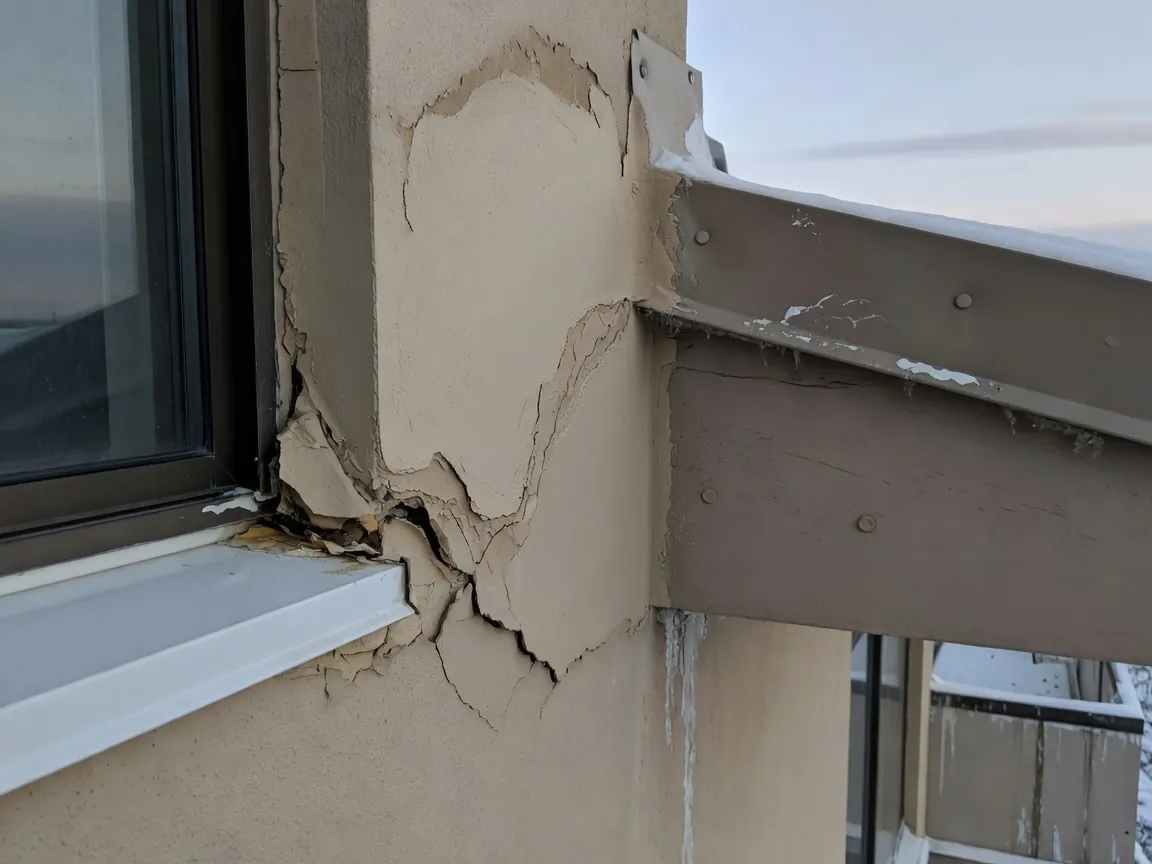
Natural Resources Canada's homeowner guide 'Keeping The Heat In', which is written for houses, lists staining, mould growth and rot as indications of moisture or structural problems in a wall. It also lists cracks in the inside and exterior wall finishes, and windows and doors that do not operate properly because they are out of square.
The 2015 Construction Performance Guide for New Home Warranty in Alberta, which says its views do not necessarily represent those of the Government of Alberta, adds that stucco separating from its base may indicate trapped moisture or a problem with adjacent flashing details. It says the cause should be ascertained before repairs.
Next step. Record where and when each sign appears, and bring the record to the engineer or envelope consultant the board consults.
Sources: Keeping The Heat In, Construction performance guide for new home warranty in Alberta
Why is caulking alone not enough to keep water out of a wall?
Natural Resources Canada's homeowner guide, which is written for houses, calls exterior caulking the last and weakest defence against rain entering a wall from the outside. It says the most effective defence against window and door wall leakage includes properly applied flashing and a properly detailed drainage plane.
A January 2004 Alberta Municipal Affairs information bulletin on stucco cladding for housing says stucco is not impermeable and moisture soaks through sooner or later. It says what is important is how fast the cladding can dry out and moisture exit, and lists membrane integrity, flashings, adequate overhangs and detailing, especially at openings, as things to consider.
Next step. Ask whether a repair scope covers flashing and drainage details at openings, not only new sealant.
Sources: Keeping The Heat In, Information Bulletin 97-IB-031R1
Can stucco be repaired instead of replaced?
Sometimes. CK's website describes one project, Aspen Close, where contractors quoted that the 40-year-old stucco needed to be removed and replaced, but further inspection found the stucco and underlay siding in good enough condition not to replace completely. Damaged sections were repaired and the stucco was coated with an elastomeric coating to seal it.
That is one project and does not show that repair is right for another. A joint practice bulletin of the Alberta Association of Architects and APEGA defines a repair of a building envelope as reconstruction or replacement of specific elements because of a premature failure that is non-systemic. Such a repair is focused on one aspect of the construction or localized to one area of a building.
Next step. Whether repair is enough for this building is for the corporation's engineer to say; ask whether the failure is localized or systemic and what a repair would and would not fix.
Sources: CK Condominium home page, Functional Relationships for the Building Envelope Portion of Projects
What is the difference between repair, rehabilitation and renewal of a building envelope?
In a joint practice bulletin of the Alberta Association of Architects and APEGA (version 1.1, May 2024), a repair deals with specific elements or one area, while rehabilitation and renewal are systemic programs. Rehabilitation is most often initiated because of premature failure, while renewal is needed because of normal wear and aging.
The bulletin defines a repair as reconstruction or replacement of specific elements because of a premature failure that is non-systemic, focused on one aspect of the construction or localized to one area of a building. Rehabilitation is a program of comprehensive, systemic reconstruction. Renewal is a program of systemic reconstruction or replacement of aged elements. These are the bulletin's own definitions, not statutory ones, and it does not define 'premature' further.
Next step. Ask the engineer which of the three the recommended work is, and why.
Sources: Functional Relationships for the Building Envelope Portion of Projects
What is a test unit or deconstructive test, and who should do the testing?
The sources cited here do not define either term or say who must do the testing. Both terms appear on CK's own website, and the working with CK page sets out what CK says about them.
On who to consult, CMHC's air leakage manual says that if a moisture problem is confined to one or a few specific areas, it may be necessary to consult an engineering or architectural firm that specializes in building envelope work before beginning any remedial actions. It does not say who must do testing.
Next step. If testing is proposed, ask the engineer to state in writing where the tests will be done, what will be opened up and what the report will say.
Sources: CK Condominium services page, CK Condominium FAQ page, Air Leakage Control for Multi-Unit Residential Buildings
What does a building envelope condition assessment cover?
None of the sources cited here defines what a building envelope condition assessment must cover. A joint practice bulletin of the Alberta Association of Architects and APEGA lists building envelope condition assessments among services a registered professional may provide.
For comparison, a 2003 CMHC manual written for co-operative and non-profit housing providers, not condominium corporations, describes a Condition Survey. It says the survey contains information about immediate or possible problems with a property's condition and is usually prepared by a qualified engineer, an inspector or a building science specialist. Section 45.95 of the Condominium Property Regulation says a technical analysis must describe, among other things, the condition of the building envelope. That is a rule for new buildings: a technical analysis is not needed for a building in which a unit was already occupied before Part 3.2 came into force.
Next step. Before hiring anyone, ask for a written scope that says what will be inspected, what will be opened up and what the report will say.
Sources: Functional Relationships for the Building Envelope Portion of Projects, Capital Replacement Planning, Condominium Property Regulation
How can a board check that an engineer is licensed in Alberta?
Use APEGA's member directory, which APEGA calls the only official directory for confirming whether an engineer or geoscientist is licensed to practise in Alberta. APEGA says the directory is updated every 24 hours.
APEGA says only professional members and companies (permit holders) licensed by APEGA have the right to independently practise engineering or geoscience in Alberta. It also says companies without a Permit to Practice from APEGA are not allowed to practise engineering or geoscience or use reserved titles. APEGA's page confirms licensing only; it does not vouch for a professional's competence or experience with stucco or envelope work.
Next step. Check the individual engineer in the directory before signing, ask whether the engineering company holds an APEGA Permit to Practice, and ask about envelope experience separately.
Is a reserve fund study the same as a building envelope assessment?
No, not as Alberta's Condominium Property Regulation (current as of 15 February 2026) describes the study. The provider must conduct an on-site visual inspection of all visible components of the depreciating property (section 23(2)(a.1)), and the sources read for this page contain no rule requiring the study to include invasive testing or a building-envelope condition assessment.
A joint practice bulletin of the Alberta Association of Architects and APEGA says a registered professional may provide building envelope condition assessments, among other services.
Next step. Ask the study provider and the engineer, in writing, what each report will and will not examine, and see the reserve fund questions for what a study must include.
Sources: Condominium Property Regulation, Functional Relationships for the Building Envelope Portion of Projects
What happens if rot is found when the wall is opened up?
Health Canada and Natural Resources Canada both say to deal with the moisture problem first, but in guides about homes, not condominium projects. Natural Resources Canada says moisture or structural problems should be addressed before insulating a wall, and lists rot among the indications of problems. Health Canada says the underlying water or moisture problem that led to mould growth should be fixed first so mould does not return.
Health Canada's guide also says the building envelope must be repaired if moisture or water is entering a home from the outside. It is a guide to indoor moisture and mould, is not written for condominium boards or envelope projects in progress, and does not say who pays.
Next step. Ask each bidder how extra work for rot will be priced, and who confirms that it is needed before it is done; working with CK sets out what CK says it does when rot is discovered.
Sources: Keeping The Heat In, Guide to addressing moisture and mould indoors
How long does stucco last on a multi-unit residential building?
CMHC's 2003 Capital Replacement Planning Manual lists stucco on exterior walls of multi-unit residential buildings with a low-end average service life of 17 years, a high-end average of 25 years and a median of 21 years. CMHC says its table is only a guide.
The figures come from CMHC's May 2000 publication, based on a survey of experienced building professionals across Canada using information dated 29 February 1996. CMHC says actual useful life can vary quite a lot with the quality of design, installation and materials, and that use and maintenance levels also affect it. The manual is written for co-operative and non-profit housing providers, and the table is not specific to Alberta.
Next step. Ask the engineer what the wall's condition, not only its age, says about how much longer it can stay in service; the balcony figures from the same table are in roofs, windows and balconies.
Sources: Capital Replacement Planning
What do CMHC and Natural Resources Canada advise about moisture and air leakage in walls?
CMHC's manual on air leakage control in multi-unit residential buildings says moisture carried by air leakage can deteriorate exterior cladding such as stucco. It also says that if a building has rain penetration or water leakage problems, air leakage control projects should not be implemented until those problems are dealt with. Natural Resources Canada says moisture or structural problems should be addressed before insulating a wall.
CMHC's 2003 operations manual for owners and managers of multi-unit residential buildings says leaks and other moisture issues should always be dealt with immediately. It advises inspecting the exterior at least once a year, preferably in the spring. This is federal guidance, not Alberta law.
Next step. Decide who will inspect the exterior at least once a year, preferably in the spring, and ask the engineer what to look for.
Sources: Air Leakage Control for Multi-Unit Residential Buildings, Keeping The Heat In, Operations Manual for Owners and Managers of Multi-Unit Residential Buildings
Does a new-home warranty cover the building envelope of a new condominium?
Alberta.ca says the New Home Buyer Protection Act requires minimum warranty coverage on all new homes, including five years for building envelope protection, which it describes as the shell of the home, including the roof and walls. Section 1(1)(s) of the Act includes the common property, common facilities and other assets of a condominium corporation in its definition of a new home.
Alberta.ca adds that warranty providers must offer builders the option of an additional 2 years of building envelope coverage. It says the requirement applies to homes built under a building permit applied for after February 1, 2014. The Act's definition covers a building that is newly constructed or being constructed, intended for residential occupancy and still within its protection period. Alberta.ca's page does not say when coverage ends for a particular building or what a claim requires.
Next step. Find the building's warranty policy and check what it covers, when coverage ends and what a claim requires.
Sources and further reading
Each answer names the public document behind it. Statements about how CK works come from CK's own website; everything else comes from the organisation named, read on the date shown at the top of this page.
- Condominium Property Regulation, Alta Reg 168/2000 (current as of February 15, 2026, amendments to AR 23/2026) — Alberta King's Printer (Government of Alberta)
- Condominium Property Act, RSA 2000, c C-22 (office consolidation, current as of May 14, 2026) — Alberta King's Printer (Government of Alberta)
- Operations Manual for Owners and Managers of Multi-Unit Residential Buildings — Canada Mortgage and Housing Corporation (CMHC)
- Functional Relationships for the Building Envelope Portion of Projects, Joint Practice Bulletin (AAA and APEGA), Version 1.1 — Alberta Association of Architects (AAA) and APEGA
- APEGA Member Directory — Association of Professional Engineers and Geoscientists of Alberta (APEGA)
- Air Leakage Control for Multi-Unit Residential Buildings (CMHC, March 2017 revision) — Canada Mortgage and Housing Corporation (CMHC)
- Owning a Condominium (tip sheet), March 2026 — Service Alberta and Red Tape Reduction (Government of Alberta)
- Keeping The Heat In - Section 7: Insulating Walls: insulating, renovating and building additions — Natural Resources Canada (Government of Canada)
- Construction performance guide for new home warranty in Alberta (September 2015; running title 'Performance Guide: NHBPO 09/01/15') — Alberta Municipal Affairs (Government of Alberta)
- Keeping The Heat In - Section 8: Upgrading windows and exterior doors — Natural Resources Canada (Government of Canada)
- Information Bulletin 97-IB-031R1: Stucco exterior cladding for housing (January 2004) — Alberta Municipal Affairs and Safety Codes Council (Government of Alberta)
- CK Condominium home page (ckcondominium.ca) — CK Condominium Consultants (its own website)
- CK Condominium services page (ckcondominium.ca/services/) — CK Condominium Consultants (its own website)
- CK Condominium FAQ page, "How is CK Condominium Different?" (ckcondominium.ca/resources-eg/) — CK Condominium Consultants (its own website)
- Capital Replacement Planning: Manual for Co-operative and Non-Profit Housing Providers — Canada Mortgage and Housing Corporation (CMHC)
- Right to Practise & Title — Association of Professional Engineers and Geoscientists of Alberta (APEGA)
- Guide to addressing moisture and mould indoors — Health Canada (Government of Canada)
- New home warranty: Overview (Alberta.ca) — Alberta Municipal Affairs (Government of Alberta)
- New Home Buyer Protection Act, SA 2012, c N-3.2 (Office Consolidation, current as of December 1, 2025) — Alberta King's Printer (Government of Alberta)