
Board questions
Parking lots, concrete and grounds: permits, drainage, snow, lighting and EV chargers
These answers cover the outdoor common property of an Alberta condominium: parking lots, concrete, drainage and grading, snow and ice, lighting, EV charging and landscaping. They rest on City of Edmonton and EPCOR bylaws and pages, Alberta statutes and regulations, Service Alberta, a national EV guide and, where stated, CK's own website. Some of those texts do not say who counts as the owner of condominium common property, and the answers say so where it matters. Whether a particular job needs a permit is for the City to confirm.
Last reviewed . General information for condominium boards, not legal or engineering advice.
At a glance
- Edmonton's Zoning Bylaw 20001 exempts a parking facility use with no exterior alterations and, where applicable, no added floor area from a development permit, but neither it nor the City's changes page says whether resurfacing, sealing or crack repair counts.
- Service Alberta's March 2026 tip sheet names the asphalt in the parking lot, underground utilities or services and landscaping as common property that needs repair and maintenance as buildings age.
- Edmonton's EPCOR Wastewater Services Bylaw makes the Owner of a premises responsible for maintaining its Private Drainage System, and the City's Commercial Lot Grading Guidelines say the person responsible must maintain surface grades in perpetuity after Final Grade Approval.
- The City says its Community Standards Bylaw 14600 does not provide a timeframe for sidewalk snow removal and that snow and ice are to be removed from the sidewalks as quickly as possible.
- The City's commercial electrical permit page lists lighting retrofits and electric vehicle charging station installation among work that needs an electrical permit.
- Alberta's Condominium Property Act (current to May 2026) and Regulation (current to February 2026) do not mention EV charging; a 2020 national guide and the Schedule 4 default bylaws each speak to board approval.
Questions and answers
Does a parking-lot project in Edmonton need a development permit?
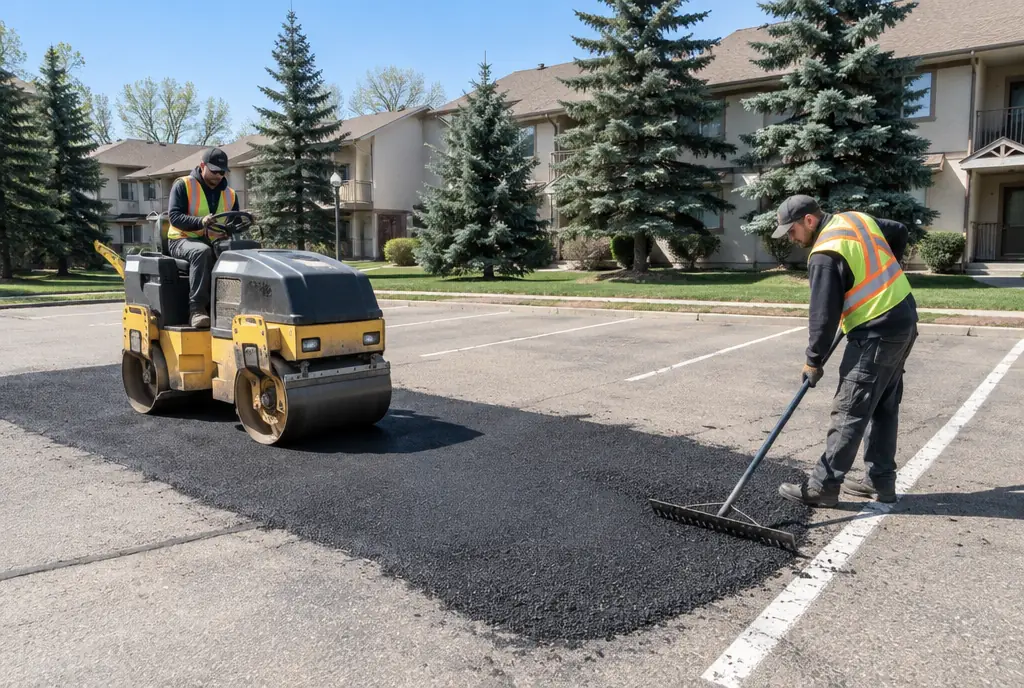
Not always. The City of Edmonton's Zoning Bylaw 20001 says no development permit is needed for a parking facility use that does not result in exterior alterations to the site, surface parking lot or parkade. But neither the bylaw nor the City's site-changes page says whether resurfacing, sealing, crack repair or other re-striping counts as an exterior alteration or needs a permit.
The exemption also requires, where applicable, no additional floor area within a parkade or surface parking lot (section 7.120, subsection 7.4). The bylaw defines 'Parking Facility' as parking on a site that has any principal use other than standalone parking facilities. The City's page lists changes to existing site layouts, such as parking aisles, and to site grading among those that need permits, and says site changes include line striping affecting accessible parking stalls.
Next step. Describe the exact work to the City of Edmonton and ask which permits, if any, it needs before the contract is signed; permits and safety covers the wider picture.
Sources: City of Edmonton Zoning Bylaw 20001, City of Edmonton Zoning Bylaw 20001, Changes to Existing Buildings and Sites
Who is responsible for maintaining the parking lot and other common property?
The Condominium Property Act makes it the condominium corporation's duty to keep common property in a state of good and serviceable repair and to maintain it properly. Service Alberta's March 2026 tip sheet names the asphalt in the parking lot, underground utilities or services, and landscaping as examples of common property that needs repair and maintenance as buildings age.
That duty is in section 37(2)(a), which also covers the corporation's real and personal property and managed property. Section 50 lets a corporation, by bylaw, lease, licence or other instrument, give an owner exclusive possession of an area and require that owner to maintain and repair it; how far that goes depends on the instrument the corporation uses.
Next step. Check your condominium plan and bylaws to see what is common property and whether any exclusive-use areas have been granted.
Sources: Condominium Property Act, Owning a Condominium
Does the City of Edmonton say anything about caring for concrete on condo grounds?
Yes, Edmonton's Community Standards Bylaw 14600 lists a concrete pad, slab or base among the examples of a 'structure' for Part II (Property Maintenance). It says a person shall not cause or permit a nuisance in respect of a structure on land they own or occupy, and sets no inspection or repair interval.
A nuisance in respect of a structure means the structure, or any portion of it, showing signs of a serious disregard for general maintenance and upkeep, with examples that include any damage to the structure. The bylaw does not define 'damage' or name sidewalks, curbs or stairs. If salt or ice melter is used, the City's 2025 sheet for businesses says concrete-friendly or pet-friendly mixtures contain less chloride and will be less damaging to concrete, but may need to be applied more often.
Next step. Ask the City how it applies this bylaw to damaged concrete at your site before you set a repair schedule.
Sources: Bylaw 14600, Snow & Ice Control
Who is responsible for a condo's private drainage system and catch basins?
Edmonton's EPCOR Wastewater Services Bylaw 20865 says the Owner of a premises shall be responsible for the construction, maintenance and repair of the Private Drainage System. The City's Commercial Lot Grading Guidelines (August 2025) describe a private drainage system as on-site facilities, including catch basins, area drains and storm sewer pipes. Neither says who the owner is for a condominium's common property.
The EPCOR wording is in Schedule 2, section 4.11, and the guidelines' description is City guideline wording, not a bylaw definition. Drainage Bylaw 18093 also says a person responsible, owner or developer shall not cause or permit alteration, removal or destruction of a private drainage system or drainage device installed on private property that the City Manager required or approved. The bylaw does not address routine cleaning or like-for-like repair.
Next step. Ask EPCOR or the corporation's lawyer who counts as the 'Owner' of your site's drainage system, and check with the City before any catch basin is altered or removed.
Sources: Bylaw 20865, Commercial Lot Grading Guidelines, Bylaw 18093
Must a condo keep its lot grading after Final Grade approval in Edmonton?
Where the City of Edmonton's Commercial Lot Grading Guidelines (August 2025) apply, they say that after Final Grade Approval has been issued the person responsible is required to maintain the surface grades in perpetuity. They do not say who that person is for a condominium's common property. The City may at any time require maintenance or enforcement of repairs on the lot grading if alterations or settlements result in lot grading problems.
The guidelines apply to non-residential and mixed-use developments, temporary structures such as storage sheds, and residential developments with Major Development Permits, such as apartments and row houses, and they say exceptions may apply. They do not say whether a particular existing complex falls under them.
Next step. Ask the City whether the guidelines apply to your complex and who it treats as the person responsible.
Sources: Commercial Lot Grading Guidelines
Does the City of Edmonton set a deadline for clearing snow from sidewalks?
Not in its bylaw, the City says. The City of Edmonton's Residential Sidewalk Snow and Ice page says Community Standards Bylaw 14600 does not provide a timeframe for snow removal, and that snow and ice are to be removed from the sidewalks as quickly as possible. Failure to maintain sidewalks could result in a $100 fine plus the cost of snow removal, the page says.
Section 7 of the bylaw says a person shall maintain any sidewalk adjacent to land they own or occupy clear of all snow and ice. The page says the expectation is that all snow and ice be cleared to the cement/asphalt for the entire width and length of the sidewalk. The bylaw does not mention condominium corporations, and its text alone does not settle whether internal walkways count as sidewalks.
Next step. Ask the City or the corporation's lawyer which walkways on your site the bylaw covers, and write the clearing standard into the snow contract.
Sources: Bylaw 14600, Residential Sidewalk Snow and Ice
Who pays if the City clears our sidewalk snow and sends an invoice?
Answering a condominium owner's question about the invoice, the City of Edmonton's Residential Sidewalk Snow and Ice page says the charges are applied to the legal property owners' tax roll once its work is completed. For multiple owners of a property, the charges are divided equally and applied to every legal property owner. The page says condominium fees are not part of the City's review and should be discussed with the condominium association.
The owner had asked why the owner, not the association, received the invoice. The page does not say how the City identifies the legal property owners of a condominium plan, whether the corporation is invoiced, or how the charge is recovered from owners under the corporation's bylaws.
Next step. Ask the corporation's lawyer how the bylaws should handle a City snow-clearing charge that is applied to owners' tax rolls.
Sources: Residential Sidewalk Snow and Ice
What does Alberta's Occupiers' Liability Act say about hiring a snow-clearing or paving contractor?
Section 11(1) of Alberta's Occupiers' Liability Act (King's Printer text marked current as of 5 December 2019) says an occupier is not liable under that Act for damage due to the negligence of an independent contractor the occupier engaged. The Act sets two conditions: the occupier exercised reasonable care in selecting and supervising the contractor, and it was reasonable in all the circumstances that the work be undertaken.
That is not an assurance that a board is protected. The Act does not mention snow or ice, does not say what reasonable selection or supervision involves, and does not say whether a condominium corporation is an occupier of common property. Section 4(2) says the Act does not apply to 'private streets' as defined in section 78 of the Law of Property Act, and neither Act says whether a condominium's roads or parking lots are private streets.
Next step. Ask the corporation's lawyer what reasonable selection and supervision of a contractor should look like for your site.
Sources: Occupiers' Liability Act, Law of Property Act
Who owns and maintains the lights and underground power cables on a condo site?
It depends on the equipment. EPCOR says it owns and maintains security lights that illuminate public or privately owned property, such as a condo's parking lot, and the City of Edmonton says it owns all street lights. EPCOR says property owners of multi-family unit sites own and are responsible for the underground utility service cables on their property and any maintenance and repairs needed.
That includes the secondary cables, pedestals, switchgear or internal panels from the customer-owned pedestal to the meter point. EPCOR also says a person with a security light at their address pays for the electricity it uses. Its pages do not say whether a particular condominium's lot lights are EPCOR's or the corporation's own, or who counts as the person at the address. Its cable page does not define 'multi-family unit site' or say whether the corporation or the unit owners are the 'property owners'.
Next step. Ask EPCOR which lights on your site are its security lights, and call its Power Trouble line at 780-412-4500 about one that is out or flickering.
Sources: Security and Street Lights | EPCOR Edmonton, Street Lighting, Faulted Services Within Multi-family Unit Sites | EPCOR Edmonton
What does the City of Edmonton ask for when a condo applies for an EV charger permit?
The City of Edmonton's EV chargers permit and inspection sheet says installing an electric vehicle charging station requires permits, and that either the building owner or an electrical contractor can apply for the permit. It says a load calculation showing the existing electrical service is sufficient to support the charger, or plans for an Energy Management System, must be submitted with the application.
The sheet is written for buildings generally and says nothing about a condominium board's consent, cost sharing or metering. The City's commercial electrical permit page lists apartments and condos among the buildings it covers; permits and safety sets out what it says about electrical permits.
Next step. Ask the City who may apply for a condominium's charger permit, and ask your electrical contractor whether a load calculation or an Energy Management System plan will go with the application.
Sources: Electric Vehicle, Electrical Permit
Can an owner install an EV charger in an Alberta condominium?
Alberta's Condominium Property Act (current to 14 May 2026) and Regulation (current to 15 February 2026) do not mention EV charging, and two other sources speak to board approval. A 2020 guide hosted by Natural Resources Canada says boards outside Ontario have the right to determine whether to approve a charger request. Schedule 4 of the Regulation says the board's prior written consent to electrical alterations of common property must not be unreasonably withheld.
The guide was written by Pollution Probe and The Delphi Group and funded by Natural Resources Canada; it is a national statement, not a reading of Alberta law. Schedule 4 holds the default bylaws, which apply only until a corporation replaces them with registered bylaws; it is not EV-specific, and it also requires the owner to ensure that all permits required under law have been obtained.
Next step. Read the corporation's registered bylaws first, and ask its lawyer whether Schedule 4 or those bylaws govern an owner's charger request.
Sources: Guide to Electric Vehicle Charging in Multi-Unit Residential Buildings, Condominium Property Regulation
Do landscaping changes on a condo's grounds need a permit in Edmonton?
It depends on the change. The City of Edmonton's Zoning Bylaw 20001 says no development permit is needed for landscaping where the existing grade and natural surface drainage pattern are not materially altered, if it complies with the bylaw's landscaping section. The City's site-changes page lists changes to existing site layouts, such as landscaping (including landscape islands), and to site grading among those that need permits.
The exemption (subsection 7.1 of section 7.120) does not apply where the landscaping forms part of a development that requires a development permit, and it does not say what 'materially altered' means. Where a development permit makes an approved landscape plan a condition, changes to that plan must be approved by the Development Planner before the landscaping is installed.
Next step. Ask the City whether your planting or grading plan alters grade or drainage, and whether the site has an approved landscape plan.
Sources: City of Edmonton Zoning Bylaw 20001, City of Edmonton Zoning Bylaw 20001, Changes to Existing Buildings and Sites
What does Edmonton's Community Standards Bylaw require for elm trees and grass on condo grounds?
Section 35 of Edmonton's Community Standards Bylaw 14600 says a person who owns or occupies land shall keep every elm tree pruned so that it is free of dead or dying wood, and shall not prune an elm after March 31st and before October 1st. The City's Tree and Plant Complaints page says the bylaw also requires private properties to keep grass and weeds no higher than 10cm.
An Inspector may order or permit otherwise, and the City's Dutch elm disease page says a permit is needed before pruning an elm during the ban for safety, disease or damage. The Tree and Plant Complaints page adds that trees on private property must be maintained so they do not overhang or block pedestrians and motorists using sidewalks and roads. The bylaw does not mention condominiums.
Next step. Put the elm pruning ban and the grass and overhang rules into the landscaping contract, and get any permit before pruning starts.
Sources: Bylaw 14600, Dutch Elm Disease, Tree and Plant Complaints
What parking-lot, concrete and grounds work does CK say it oversees?
CK says it oversees a wide range of construction management, exterior building, parking and ground services for condo boards. Its services page lists asphalt repair and complete replacement programs, including catch basin and barrel repair and replacement, and concrete lifting (mudjacking) including epoxy crack filling, and concrete replacement.
The page also lists car-plug maintenance and replacement programs; LED light replacement for apartment-style condominiums and existing and new street lights; and landscape and grade programs, including working with the City of Edmonton on the Final Grade Certificate and compliance.
Next step. See the services page for the full list, and ask CK which of these programs fits your site.
Sources: CK Condominium services page
Sources and further reading
Each answer names the public document behind it. Statements about how CK works come from CK's own website; everything else comes from the organisation named, read on the date shown at the top of this page.
- City of Edmonton Zoning Bylaw 20001, 7.120 No Development Permit Required
- Changes to Existing Buildings and Sites — City of Edmonton
- Owning a Condominium (tip sheet), March 2026 — Service Alberta and Red Tape Reduction (Government of Alberta)
- Bylaw 20865, EPCOR Wastewater Services Bylaw (Schedule 2, s.4.11) — City of Edmonton
- Commercial Lot Grading Guidelines (August 2025) — City of Edmonton
- Residential Sidewalk Snow and Ice — City of Edmonton
- Electrical Permit - Commercial — City of Edmonton
- Guide to Electric Vehicle Charging in Multi-Unit Residential Buildings (Pollution Probe and The Delphi Group, 2020) — Natural Resources Canada (funded and hosted; written by Pollution Probe and The Delphi Group)
- Condominium Property Regulation, Alta Reg 168/2000, Schedule 4 (Bylaws of the Corporation) — Alberta King's Printer
- City of Edmonton Zoning Bylaw 20001, 8.10 Use Definitions
- Condominium Property Act, RSA 2000, c C-22 (office consolidation, current as of May 14, 2026) — Alberta King's Printer (Government of Alberta)
- Bylaw 14600, Community Standards Bylaw (consolidated October 22, 2024) — City of Edmonton
- Snow & Ice Control - 2025 Information Sheet for Businesses — City of Edmonton
- Bylaw 18093, Drainage Bylaw (consolidated May 12, 2025) — City of Edmonton
- Occupiers' Liability Act, RSA 2000, c O-4 — Alberta King's Printer
- Law of Property Act, RSA 2000, c L-7 — Alberta King's Printer
- Security and Street Lights | EPCOR Edmonton
- Street Lighting — City of Edmonton
- Faulted Services Within Multi-family Unit Sites | EPCOR Edmonton
- Electric Vehicle (EV) Chargers Permit and Inspection Process — City of Edmonton
- City of Edmonton Zoning Bylaw 20001, 5.60 Landscaping
- Dutch Elm Disease — City of Edmonton
- Tree and Plant Complaints — City of Edmonton
- CK Condominium services page (ckcondominium.ca/services/) — CK Condominium Consultants (its own website)